


Why travellers are obsessed with foreign supermarkets

 Getty Images
From Tokyo egg sandwiches to Greek dairy aisles, supermarket aisles are becoming one of travel’s most revealing and beloved experiences.
It’s 10:00 in a Tokyo 7-Eleven, and I am standing shoulder to shoulder with a dozen tourists, all clutching baskets loaded with the same things: fluffy egg mayo sandwiches, katsu curry buns, matcha Kit Kats and warm cans of Boss coffee pulled from heated shelves. Behind me, someone photographs their haul before they’ve even reached the till. Every few seconds, the familiar convenience-store chime announces another arrival. Nobody is here because they have run out of toothpaste. We are all, quite openly, shopping for the experience.
It is a travel ritual I’ve found myself repeating across the globe. I once spent an unreasonable portion of a sweltering Barcelona afternoon navigating the crowded aisles of a basement Mercadona, hunting down jars of pistachio cream. In a chaotic Miami Trader Joe’s, I bypassed the groceries entirely and bought six jars of Everything But the Bagel seasoning, then repacked my suitcase around them before flying home.
What began as a holiday necessity has gradually become one of my favourite parts of travelling, anticipated and increasingly built into the itinerary rather than squeezed in around it. As it turns out, I’m not alone. Hilton’s 2026 Trends Report found that 77% of travellers enjoy visiting grocery stores abroad, while Condé Nast Traveller recently named grocery tourism one of the biggest travel trends of 2026.
We might not all be able to afford a Michelin-starred meal or a private food tour, but almost anyone can spend €10 filling a basket with local snacks, unusual drinks and ingredients they’ve never seen before
The industry has noticed too. Earlier this year, K-Supermarket, one of Finland’s largest grocery chains, became the first supermarket in the world to officially list its branches as tourist attractions on Tripadvisor. Among them is a Helsinki store built around rooftop beehives that produce their own honey and another lauded for its craft beer selection, with each branch independently run and adapted to its local community.
Why supermarkets feel different abroad
Away from traditional sightseeing, ducking into a local grocery shop remains a surprisingly raw way to travel. Nothing on the shelves has been curated for out-of-towners or stamped with a tourist board’s seal of approval. In an era of timed-entry museums and viral photo spots, wandering the aisles of a neighbourhood grocery store feels wonderfully unscripted
Monuments reveal how a country remembers its past, but a supermarket shows how it lives today. You quickly learn what people eat for breakfast, whether nappies are kept behind the counter and just how many varieties of tinned fish a country considers reasonable. The person queuing beside you isn’t there to sightsee. They’re simply buying dinner. For a few minutes, tourists and locals occupy the same space, following exactly the same routines.
 Getty Images
And there’s a scientific explanation for why those convenience store snacks seem to taste so good. When I ask Oxford experimental psychologist Professor Charles Spence why supermarket food seems to take on an almost mythical quality abroad, he points to what he calls a “slightly less glamorous” version of the Provençal Rosé Paradox, the psychological phenomenon whereby a wine tasted on one’s summer holidays never quite matches up when opened back home on a cold and rainy winter’s night. In the supermarket aisle, context is everything.
Most of us have lived some version of it. A flavour of Lay’s crisps you’ve never seen before, eaten on a sunny holiday balcony, somehow loses a little of its magic once it’s opened back home. According to Spence, supermarket discoveries work in much the same way. That egg mayo sandwich from Tokyo or a packet of crisps picked up abroad isn’t being judged on flavour alone; the atmosphere and environment become part of the tasting experience.
 Getty Images
You don’t need a generous budget to take part, either. We might not all be able to afford a Michelin-starred meal or a private food tour, but almost anyone can spend €10 filling a basket with local snacks, unusual drinks and ingredients they’ve never seen before. Unlike a museum or a guided tour, a supermarket doesn’t hand us an experience. We put it together ourselves.
The appeal of shopping like a local
Consumer psychologist and Humanising Brands founder Kate Nightingale believes the supermarket trend reflects a broader shift in what travellers are looking for. Increasingly, she says, we’re seeking moments that feel authentic, participatory and accessible. Rather than simply observing a destination, we want to feel part of it.
More like this:
A foreign supermarket offers exactly that. Its layout and routines are almost universally understood. We know how to pick up a basket, browse the aisles and join the queue. As Nightingale explains, “familiarity frees our brains to become more exploratory, allowing us to notice everything that’s different rather than worrying about how to navigate the space”. She likens it to the instinct that lets a child confidently run off to explore a playground once they know a parent is nearby.
Back home, supermarkets are usually somewhere to get in and out of as quickly as possible. Abroad, they have a habit of drawing us in. We pause over fruit we’ve never seen before, try to make sense of products from their colours and pictures, or realise we’ve spent several minutes staring at shelves devoted entirely to seaweed. The weekly shop becomes something we notice rather than simply get through.
 Getty Images
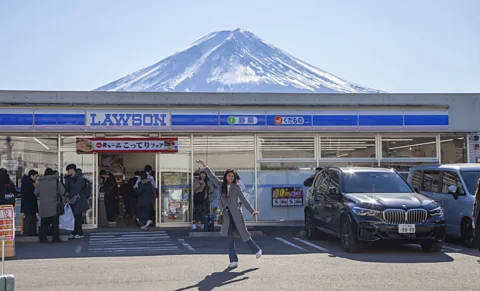
There is, however, a point at which supermarket tourism begins to eat itself. In Kawaguchiko, Japan, a Lawson convenience store became so overwhelmed by visitors photographing its roof framed against Mount Fuji that authorities deployed security guards, traffic barriers and crowd-control teams to manage the chaos, eventually erecting a giant black screen to block the view. The irony is hard to miss: a supermarket only works as a slice of normal life because nobody is putting on a show for you. Once tourists outnumber locals, it stops being an ordinary shop.
Of course, none of that crossed my mind the afternoon I stood in front of a dairy fridge in Athens looking at rows of white tubs, their labels entirely indecipherable. I turned them over one by one, searching for a single word I recognised, when a woman reached past my shoulder and grabbed one without slowing her trolley. I bought the same tub. It remains the best yoghurt I’ve ever eaten.
—
If you liked this story, sign up for The Essential List newsletter – a handpicked selection of features, videos and can’t-miss news, delivered to your inbox twice a week.
Original source: https://www.bbc.com/