

Three storms strike Asia in a week battering millions with heavy rain and strong winds

Summary
-
China, Japan and the Philippines are reeling from back-to-back storms, with at least three churning across the Pacific at the same time
-
The remnants of Typhoon Dolphin, which slammed eastern China earlier this week, is expected to bring torrential rains to Beijing today, as it moves inland as a weakened tropical storm
-
In Japan, Typhoon Chan-Hom lashed the Kanto region, which includes Tokyo, overnight and has since weakened into a tropical depression
-
Another tropical storm, Nangka, has formed south of Japan and is forecast to move north.
-
In the Philippines, at least 26 people have died after floods and landslides triggered by the seasonal monsoon and a succession of storms, including Dolphin
-
Elsewhere in the Pacific, Tropical Storm Peilou is churning east, off the Philippines eastern coast, and moving away from Asia
-
Remnants of Typhoon Dolphin continue to drench Beijingpublished at 04:56 BST
 Image source, AFP via Getty Images
Typhoon Dolphin, the strongest storm to hit China this year, has since weakened as it moved inland.
But it is forecast to bring more rain to China’s eastern and northern regions in the coming days, including the capital Beijing, according to Chinese state media.
Much of the capital is expected to receive more than 150mm of rain between Tuesday evening and Thursday, state media report. Some cities in central China recorded their highest amount of rainfall in a single day.
Some train services have been suspended, and flood warnings have been issued. A number of reservoirs have exceeded their flood-control limits, according to reports.
-
Typhoon weather in Chinapublished at 04:43 BST
Typhoon Dolphin’s winds have weakened significantly since it made landfall earlier this week, but it continues to stir heavy rains as it moves inland. Flood alerts are up in Beijing today.
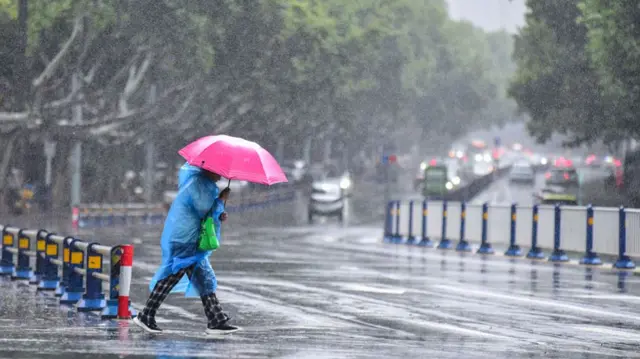 Image source, Getty Images
Image caption, A padestrian in Fuyang city, Anhui province attempts to cross the street under heavy rain
 Image source, Getty Images
Image caption, High waves crash near Daquangou Fishing Port in Shandong province
 Image source, Getty Images
Image caption, A man shelters under an umbrela while standing in knee-deep floods in Taizhou, Zhejiang province
 Image source, Getty Images
Image caption, Cars attempt to navigate a flooded street in Taizhou, Zhejiang province
-
China’s new challenge as natural disasters strike – fake AI videospublished at 04:27 BST
As weather events become more extreme, fake videos are being shared rapidly online, and it’s causing real world problems in China.
The BBC analysed videos purportedly from the aftermath of Typhoon Noul in July.
Media caption, AI or real? BBC analyses viral China disaster videos
-
Fourth storm has formedpublished at 04:26 BST
As Asia continues to battle wet weather brought by three simultaneous storms in the region, they’re bracing for another one.
Typhoon No. 17, also known as Nangka, has formed near Japan’s southern islands this morning, according to the Japan Meteorological Agency (JMA).
Philippine authorities say they are monitoring it as well.
It’s expected to maintain its strength as it moves across the water in the coming days, according to a forecast by the JMA.
-
Asia battered by three typhoons in a weekpublished at 03:27 BST
 Image source, Getty Images
Image caption, Typhoon Dolphin as seen from space
The Pacific typhoon season is in full swing. In this part of the world, storms form over the Western Pacific then move west towards the Philippines, Japan, Hong Kong, China and Vietnam.
Typhoon Dolphin followed that track over the past few days, sweeping through Japan’s southern islands, just north of the Philippines, before slamming into the eastern coast of mainland China on Sunday.
Also on Sunday, Typhoon Peilou formed in the northwestern Pacific Ocean – though it has since weakened without making landfall.
As southern Japan was battling Dolphin, Typhoon Chan-Hom made landfall over mainland Japan on Tuesday.
Chinese state media described Dolphin, Chan-Hom and Peilou as a rare “three-typhoon situation” in the region. All three typhoons have since weakened.
These typhoons (called hurricanes in the Atlantic) can cause widespread flooding, storm surges and landslides. They can also be deadly, especially when they hit densely populated areas.
In the Philippines, heavy rain have killed at least 26 people – many of whom died in landslides, authorities said.
-
Flood warnings in Beijingpublished at 03:26 BST
 Image source, Getty Images
On average, 528mm (20.8 inches) or rain falls on Beijing every year, mostly between June and September.
From Tuesday evening through Thursday, authorities have warned that in most areas in Beijing, 100mm (3.9 inches) of rain will fall in six hours and more than 150mm (5.9 inches) in 24 hours.
In the districts of Tongzhou, Daxing, Fangshan, Mentougou, Huairou, and Fengtai, rainfall might exceed 200mm (7.9 inches) in 24 hours.
Typhoon season has brought widespread flooding to Beijing and surrounding areas in recent years.
-
Storms sweep through Asiapublished at 03:25 BST
 Image source, Getty Images
It is a very wet morning across many parts of East and South East Asia this morning, where three storms were recorded in a week.
Parts of China saw torrential rains and floods overnight as Typhoon Dolphin swept into parts of the country’s eastern and central region. The capital Beijing is bracing itself for more than one third of the region’s annual rainfall in 24 hours. Dolphin weakened after making landfall on Sunday.
In Japan, Chan-Hom is sweeping through the country’s mainland, where weather officials have warned of landslides, swollen rivers and flooding in low-lying areas.
And in the Philippines, over a week of non-stop monsoon rains stirred by Pacific typhoons, including Dolphin, have left at least 26 people dead. A third storm, Peilou, is churning eastwards, off the country’s east coast.
Stay with us for the latest updates.
Original source: https://www.bbc.com/