

The invisible price of travelling safely as a woman

 Getty Images
Women-only rooms are in high demand – and sometimes cost more. What does that tell us about the price of feeling safe?
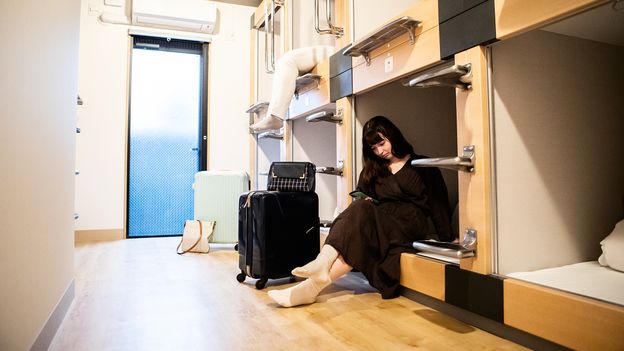
At 23:00 on a wet Friday night in central London, I’m standing in the glowing lobby of a pod hotel in Piccadilly Circus staring at two nearly identical booking options on a self-service screen. A capsule on a mixed-gender floor costs £35 ($47) whilst a capsule on the women-only floor is £45 ($60).
The extra £10 doesn’t buy a bigger room, complimentary breakfast or a better view. The capsules are exactly the same: compact cocoons fitted with a mattress, mood lighting and just enough space to fully open a small suitcase. What the nearly 30% surcharge offers instead is a keycard-restricted corridor, a floor without men and, perhaps most importantly, the promise of sleeping a little easier in an unfamiliar city.
Most of the women around me barely glance at the price difference. But as I tap my card against the reader, I realise I’m not really weighing one room against another. I am weighing whether my peace of mind is worth the extra £10.
Because of the heightened risks of sexual harassment, physical assault and unwanted attention, travel often comes with a series of financial trade-offs for many women, such as paying more for centrally located hotels, taking taxis rather than walking at night or choosing women-only spaces over cheaper mixed accommodation.
It’s tempting to compare this with the “pink tax”, the term used to describe products or services marketed to women at a higher price than equivalent versions for men. But the costs of travelling safely are often less direct.
 Getty Images
Women are not necessarily being charged more for the same journey. Instead, safety concerns can push them towards different – and sometimes more expensive choices. Stephanie Boyle, campaign director of the Safer Tourism Foundation’s She Travels Safe campaign, calls it an “avoidance tax“, noting that women often alter their behaviour before anything has gone wrong.
“Women aren’t travelling less because they’re less adventurous than men,” she says. “They face a different risk environment.”
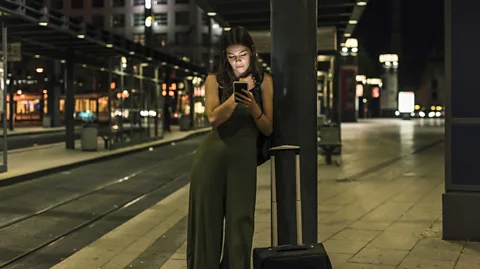
Research from the Safer Tourism Foundation, which tracks gendered travel behaviour, found that 64% of women avoid walking back to their accommodation alone at night while abroad compared to 43% of men, and 56% avoid areas they perceive as unsafe versus 37% of men who do the same. Nearly half of women (48%) avoid exploring their destination at night altogether.
These decisions also affect spending. Women are more likely to book travel insurance and more likely to pay for transport that ensures arrival in daylight hours – each choice small in isolation but collectively adding to the overall cost of travel.
When safety shapes the journey
Solo female traveller Jen Kaarlo has travelled to 53 countries, most of them alone, and says solo travel for many women often comes with constant calculations around safety. For Kaarlo, choices such as arriving in daylight, pre-booking transport and avoiding situations where she feels overly vulnerable have become almost automatic.
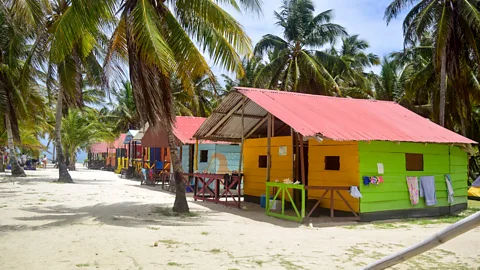
While travelling through Panama, she booked a semi-private boat trip through the San Blas Islands but paid extra to guarantee she would not have to share a sleeping space with a stranger.
 Getty Images
“In order to rent the cabin, I had to pay one fee,” she says. “Then I had to pay between $100 and $200 (£80-£160) more to ensure that I had a private boat bed.”
More routinely, she says she budgets extra for transport, particularly when arriving somewhere unfamiliar. At Charles de Gaulle airport in Paris, she encountered a man who repeatedly approached travellers with an elaborate scam, an experience that reinforced her preference for pre-booking a car or taking a taxi rather than public transport. “Probably the biggest cost generally is the extra ground transportation… I avoid mass transit anytime getting into a new city unless I know that city really well.”
Solo traveller Jodie Hughes has found something similar. Since first travelling solo as a 19-year-old, Hughes has journeyed extensively across Europe, the US, Australia and Japan, often staying in hostels to keep costs down. But she says age and experience have changed how she budgets.
Many women describe choosing convenience over spontaneity, picking more expensive options that feel safer or avoiding experiences altogether if the logistics feel risky
In Florence, she recalls accepting a lift from a man after she had been drinking, an experience she says “went pretty badly” and could have been much worse. In a similar way, Kaarlo says that after having her drink spiked in “an incredibly scary situation” in Paris, she changed how she approached solo travel.
Both women say these experiences have made them more conscious of the risks involved in travelling alone and more willing to pay for peace of mind.
“When I was younger, I’d think: ‘Oh my God, I don’t have the money for the next dorm up,'” Hughes says. “Now, I draw the line at my safety.”
 Getty Images
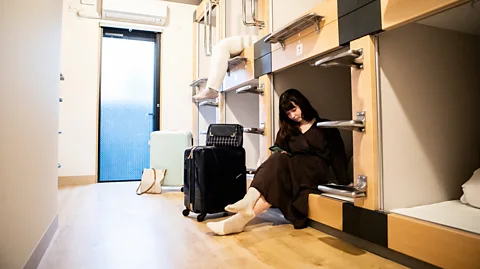
Hughes almost always books women-only dorms when available. In Japan, she says, these were often priced similarly to mixed accommodation. In parts of Europe, however, she has found female-only options more expensive. At Hostel Lybeer in Bruges, for example, a mixed dorm was recently listed at €26 (£22.25) compared with €28 (£23.95) for a woman-only down.
“I’d rather travel less frequently,” Hughes says, “but when I do travel, it’s safer.”
What is driving the cost?
The reasons why women-only accommodation can be priced differently varies across the industry, but operators say it is rarely a straightforward premium for safety.
A spokesperson for Generator Hostels says the price of female-only dorms reflect demand rather than gender-based pricing. “Female-only dorms have always been in demand – faster than we have been able to grow supply,” they say. “When demand for a specific room type consistently outpaces availability, pricing reflects that.”
But if women are seeking those rooms because they feel less safe in mixed accommodations, safety is still influencing what they pay. Boyle argues that the answer should not be to make it a premium feature. “Safety shouldn’t be a competitive component,” she says. “It shouldn’t be something that companies think: ‘We are safer and therefore we can charge more.'”
More like this:
The cost isn’t confined to accommodation. Many women describe choosing convenience over spontaneity, picking more expensive options that feel safer or avoiding experiences altogether if the logistics feel risky. The question becomes not only “Can I afford this?” but “Can I afford not to?”
And for Kaarlo, the cost is not just financial. “The cognitive overload, I think, is the biggest weight,” she says.
Back in my London pod, I settle into my capsule and text my friends to let them know I’ve arrived safely after the night out. The extra £10 had bought the feeling, however temporary, of sleeping a little easier in a big city.
But it leaves me with a more fundamental question: should feeling safe be something travellers have to pay extra for at all?
—
If you liked this story, sign up for The Essential List newsletter – a handpicked selection of features, videos and can’t-miss news, delivered to your inbox twice a week.
Original source: https://www.bbc.com/