

The influencers getting bitten while chasing the perfect shark shot

 Tayane Dalazen
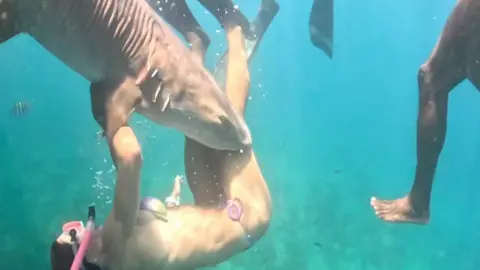
“I knew something was different because the sharks were on the surface,” says Tayane Dalazen, a 37-year old Brazilian lawyer and social media personality.
“There were a lot of them,” she says. “Later, I discovered [the tour organisers] were feeding the sharks so that they would interact with the tourists.”
Dalazen, from Sao Paulo, was on a shark-diving trip on the Brazilian coast in April when she suddenly felt “strong pressure” on her leg.
“When the shark bit me, the pain was very strong,” she says. “I stayed calm because I knew I couldn’t fight the animal.”
A nurse shark, more than seven feet (two metres) long, had clamped its jaws around her thigh.
After holding her underwater for several seconds, the shark released her and she was able to escape. But Dalazen says the experience, which left her with lacerations to her thigh, was “very frightening”.
Dalazen posted footage of the shark bite online, where it’s since been viewed tens of millions of times. Although she says she “wasn’t there for social media” and didn’t touch or provoke the shark, she admits she was too close to the animals.
 Tayane Dalazen
Incidents of sharks biting humans are incredibly rare, but at least three influencers have been bitten by the animals in less than a year. Scientists say they’re increasingly concerned about the rise in social media videos showing people swimming too close to sharks, touching or even riding them.
“I’m seeing these videos every single week now and it’s way more than it ever used to be,” says shark scientist Kristian Parton, who also hosts the ‘Shark Bytes’ YouTube channel. “We’re going to see people ending up in really serious incidents with sharks.”
In July, a fishing influencer almost lost his leg after being attacked by a reef shark whilst spearfishing. In December, a Chinese content creator was bitten in the Maldives. Both incidents were caught on camera.
Researchers at the International Shark Attack File, which tracks human-shark interactions worldwide, have also told the BBC they’ve seen a marked increase in the past three years of people being bitten while trying to take footage with sharks.
A recent study of “swim with wildlife” expeditions found influencers and photographers were the most likely to ignore safety instructions.
In February last year, a tourist in the Caribbean had both hands bitten off while trying to get a photograph of a bull shark from the shallows, according to local authorities. Two months later, a snorkeller in Israel carrying a “selfie stick” was killed by sharks, reportedly while trying to get photographs.
The risk of being bitten by a shark remains extremely low: the number of unprovoked shark attacks worldwide has remained broadly stable for the past 30 years, at about 70 bites per year.
While Tayane Dalazen was bitten by a nurse shark – known as a more docile species – some influencers have been filmed touching tiger sharks and even great whites.
“We’re talking about a true apex predator, a very large wild animal,” says Parton. “You wouldn’t walk into the Serengeti and try and put your hand on the face of a lion.”
Sharks will often use defensive or “exploratory” bites when presented by an unwelcome human in their personal space, he adds.
Human interactions can also cause stress to the animals. Scientific studies have shown that approaching or touching a shark leads to high levels of hormones called glucocorticoids. These can lead to a weakened immune system, increased mortality and aborted offspring.
“If you’re approaching the shark and stressing it out, whether it be in a nursery habitat, a breeding ground, or a feeding area, you’re depriving that shark of an area that’s important to it to survive,” explains Parton, “and that’s definitely a problem.”
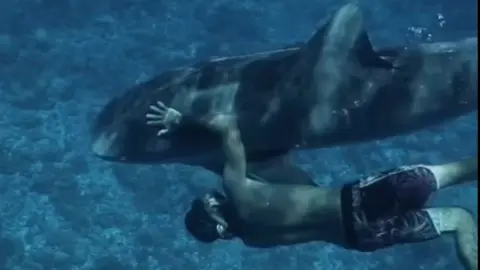
One of the best-known shark content creators is Ocean Ramsey, a 38-year-old former model who shot to fame in 2019 after she was pictured swimming with one of the largest great white sharks ever seen.
She often posts footage of her touching sharks and holding their dorsal fins.
She spoke to the BBC from a boat in Hawaii, where she runs “Dive with Ocean” shark tours for paying customers.
“My intent with all of my content has never been to gain views, it’s to gain protection for sharks,” Ramsey says. “I’ve contributed to research articles, data collection… all of my work stems down to education.”
She denies that getting close to the sharks and touching them causes harm: “Most of my work and what I share is respecting and observing from a distance,” she says.
“I observe their behaviour and they choose to interact with me. They always make the first approach.”
What about claims by scientists that videos showing sharks being touched encourage others to take risks and do the same?
“You’ve got to give the general public some accountability,” Ramsey insists. “I think most people are observing what I’m sharing with an educational message and they’re not going out to just replicate that.”
 Reuters
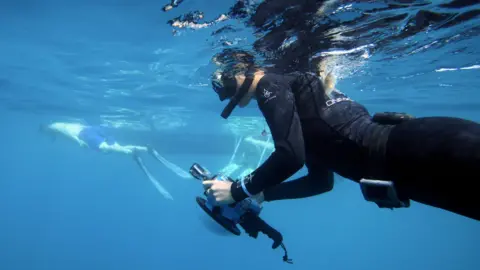
The BBC spoke to several content creators who all denied being motivated by social media views, clicks or revenue, and insisted they were supporting conservation or attempting to change public perceptions of sharks.
Shark expert Dr Jack Cooper describes those claims as “ludicrous”.
“I really cannot explain how going up to a shark and touching it or riding it is doing anything to aid conservation,” he says. “All you’re doing is showing a shark getting harassed by a human. And that’s not promoting any policies about what we could do to reduce overfishing or to give more protections for sharks.
“And it’s certainly not providing scientific data that will tell us how the shark populations are doing or what policies might actually help conserve them.”
 Denis Grosmaine
Eric Clua, a marine biologist at the École Pratique des Hautes Études in Paris, who has done research into the motivations behind shark bites, says the number of incidents caused by people getting too close to sharks is increasing, as a consequence of people considering sharks less dangerous than before.
“The message transmitted by influencers is ‘Look! Touch the shark, nothing will happen to you,'” he says.
Shark swimming and diving are booming in popularity around the world. Travel site TripAdvisor currently lists more than 140 such experiences in the Maldives alone. Some of the listings advertise “the ultimate selfie” with sharks.
But the warning from experts is clear: getting that perfect shot could come at a painful price.
Original source: https://www.bbc.com/
