

The controversial story of the North American raccoons wreaking havoc in Germany

 Alamy
AlamyGermany’s raccoons are loved by some, despised by others. Once alleged to have been introduced by a Nazi commander, many elements of the raccoons’ story have been wildly misunderstood.
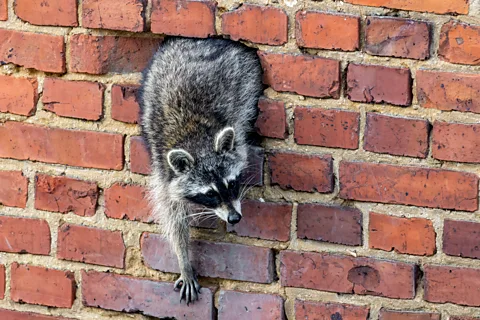
In Germany, raccoons often live up to their outlaw reputation. Labelled “bandits”, thanks to the distinctive black strip across their eyes, they have regularly made headlines for breaking into major hospitals, zoos and power stations, leaving a trail of destruction behind.
“They’re really clever, they’re able to climb everything,” says wildlife ecologist Berit Michler of Germany’s Thünen Institute. To some, they’ve become known as “smart, tricky, evil animals”.
But scientists say it’s time to sort myth from fact around Germany’s raccoons. The urban legend goes that they were introduced to the country by Nazi commander and war criminal Hermann Göring. Yet archival research and modern ecological studies now tell a different story – one that does more justice to these charismatic opportuntists, who thrive in remote forests and urban backyards alike.
The true origin story of Germany’s raccoons
Germany’s raccoons were long rumoured to have a dark past, beginning in the area near the city of Kassel in central Germany, where raccoons are now a part of daily life.
“It was a common narrative among tourist guides, local politicians and larger parts of the population that Hermann Göring himself ordered the release of the raccoons in the wild,” says Eberhard Leicht, the former head of the Vöhl Forestry Office in central Germany. “Some people even believed Göring had personally attended the process.”
Although local forestry officials cast doubt on the stories, this view spread, says Leicht. As the rumour reached as far as the English Channel, “raccoons finally made headlines in the British tabloid press”, he recalls.
 Getty Images
Leicht set out, using archival research, to see what really happened. He found that an application was indeed made to the Prussian hunting office to release two pairs of North American raccoons near the Edersee, a reservoir near the city of Kassel, to “enrich the fauna”. The application was made during the time that Göring was in charge of forestry and hunting, but Leicht found no sign that Göring had been personally involved.
“There is no indication anywhere that politicians – such as Göring, as a member of the Nazi Reich government – had any influence on the decision,” says Leicht. “The file clearly shows that the entire process was merely an administrative matter.”
As Alain Frantz, zoology curator at the Luxembourg Museum of Natural History, summarises: “The particular Nazi aspect, I think that’s a British obsession.”
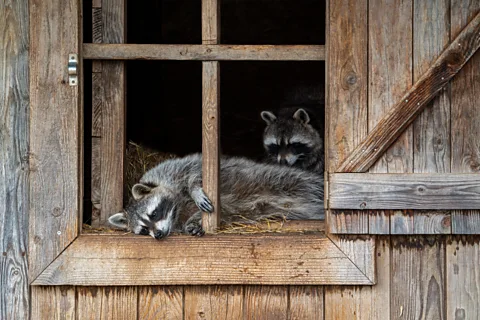
In the end, Leicht’s archival research showed that the raccoons were let loose before an application was signed. One morning in April 1934, the records show, the animals were released from two crates to the south side of Lake Edersee near Vöhl, around 50km (30 miles) to the south-west of Kassel. This population grew and grew.
Today, Kassel has been called the “raccoon capital of Europe“, with an estimated urban population of around 30,000 of the animals.
Germany’s ‘wash-bear’
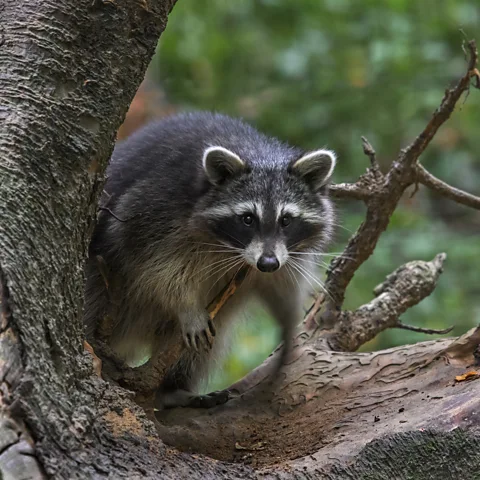
Raccoons are recognised by their distinctive black markings and dexterous hands that they use to find food and dunk it in puddles or streams. This habit has led to an array of water-based European names – including Waschbär (wash-bear) in German.
Raccoons on the run
The Lake Edersee raccoons were the first to take tentative steps into the wild in Europe. But more would soon follow.
When Frantz began researching raccoons in 2011, he was already aware of another release, believed to have occurred in the dying days of the Third Reich, when Allied bombers hit a Brandenburg fur farm.
Frantz was keen to understand if today’s population really sprang from just those two small starter populations. Such a tiny group could lead to severe genetic abnormalities as numbers grew, due to inbreeding.
By sampling the DNA of more than 400 raccoons across Germany, Frantz found evidence of two further significant releases, leading to populations with different gene pools in eastern Saxony, near the Czech border, and in the Harz Mountains, in northern Germany.
The German population is known to have spread across borders, with documented crossings into the Netherlands, the Czech Republic and Switzerland. In Central Europe, the population had grown 300% between the 1990s and 2018, expanding into new territory in cities and forests. They have been found as far afield as Spain, Sweden and Greece. There have also been ongoing escapes from captivity across Europe, including from an Italian zoo in the early 2000s.
“Generally speaking, they’re quite good at escaping,” says Frantz.
 Getty Images
Are they a ‘plague’?
Where raccoons go, a certain type of chaos typically follows. In Germany, they’ve helped themselves to mulled wine sold at German Christmas markets, leaving one animal staggering around the city of Erfurt “obviously intoxicated”, the Deutsche Welle reported.
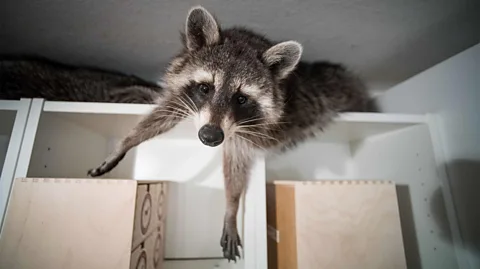
Raccoons have an unfortunate habit of establishing communal toilets, where “all of them, more or less, go in the same place”, says Arne Jernelov, a UN expert on environmental catastrophes, who has written on the long-term impacts of invasive species. “And that, of course, is not very nice if it happens to be the attic of your house.”
As their population has climbed to two million in Germany, newspapers have called raccoons an invasive “hoard“, “a plague” and a group of “little gangsters“, responsible for thousands of Euros of property damage.
But people may have been too quick to assume that the whirlwind of destruction that raccoons leave in cities means that they are a disaster for native wildlife too. As far as harming native species goes, raccoons are being framed for a crime there’s little evidence they have committed, says Michler.
Michler led a decade-long research project in Müritz National Park, the largest and longest European field study of its kind. She concluded that there is no evidence of a significant threat to Germany’s native biodiversity. Some environmentalists have even claimed that the ecological data we have does not support the EU’s designation of raccoons as an invasive species.
Raccoons’ ecological impacts in Europe remain poorly studied, says Michler. “We always need someone who’s responsible for all the evil in the world,” she says. “There are a lot of silly stories going on here in Germany about raccoons – and not enough real research behind it. That’s a big problem.”
 Getty Images
However, the extent of raccoons’ ecological impact remains a “big discussion” in Germany, says Vera Heck, managing director of the Federal Association of Wildlife Rescue Organisations in Germany.
Raccoons’ ability to climb and swim means that they can get almost anywhere. In the US, where they are native, growing raccoon numbers in certain areas have been linked to declining numbers of songbirds. In Europe, studies have indicated that raccoons eat waterbird eggs, and rare European pond turtles. They can also carry parasites that can harm humans.
A divisive animal
Some scientists have made efforts in recent years to get the species off the EU’s invasive species list, says Michler, but Germany’s hunting lobby opposes the move. In Germany, most states allow raccoons to be hunted year-round, and the number killed has quadrupled since 2005, to more than a quarter of a million.
Torsten Reinwald, spokesman for the German Hunting Association, says that some scientific studies contradict the Müritz National Park research and find negative impacts on native biodiversity. Reinwald points to research from the Goethe University Frankfurt, which found that raccoons eat amphibians and their eggs.
Public opinion remains divided, says Heck. For some, they are a pest best dealt with by calling in hunters, including for the unfortunate inebriated raccoon in Erfurt, which Deutsche Welle reported was later shot. Others find them adorable enough that nightly feeding sessions take place in many cities.
More like this:
Either way, raccoons are in Germany to stay. The overall population continues to increase and the wily mammals make their way into new areas. “At the moment they are shooting, shooting, shooting and every year there are more raccoons,” says Heck. Climate change is expected to expand their global range into new non-native areas.
In Kessel, Heck’s charity has advocated for raccoons to be sterilised and re-released, in combination with other measures, including hunting and fencing to keep them out of protected areas where they could impact rare animals. Heck hopes that balance could give people in Germany the chance to co-exist with raccoons, without surrendering to them.
—
For essential climate news and hopeful developments to your inbox, sign up to the Future Earth newsletter, while The Essential List delivers a handpicked selection of features and insights twice a week.
Original source: https://www.bbc.com/
