

Hidden manuscripts reveal medieval reading habits

 Max Rhydwen-Jones/States of Guernsey
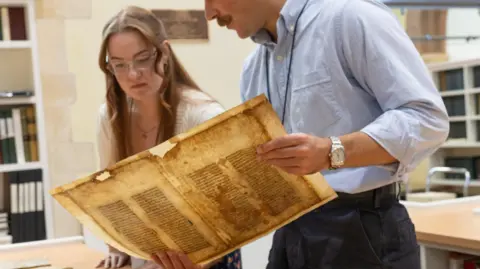
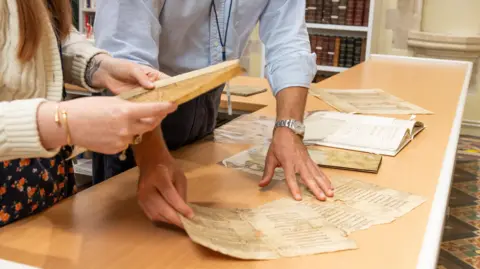
Seventeen fragments of medieval manuscripts that had been “hidden in plain sight” for centuries have been uncovered in Guernsey.
Offering insight into the island’s early literary culture, the fragments suggest late medieval Guernsey was home to keen readers, and reading in French rather than English was preferred.
Also regarded as “striking early examples of recycling”, historians found the fragments were repurposed as covers for notebooks and bindings for administrative records, meaning they were unknowingly preserved.
Prof Tamara Atkin, a book historian from the University of Oxford, said the discovery “transforms what we can now say about Guernsey’s medieval manuscript culture”.
Until now there had been virtually no evidence for libraries, collections of books or literary culture in the island during the medieval period, said the States of Guernsey.
 Max Rhydwen-Jones/States of Guernsey
Prof Atkin said the discovery showed “books of several kinds – scholastic, liturgical, and literary – were available on the island” at the time.
The fragments – found in the Island Archives and His Majesty’s greffier’s strongroom – were identified by the archive team working alongside Prof Atkin and manuscript expert Dr David Rundle, from the University of Kent.
It began when archival assistant Callum Tostevin-Hall was asked to track down a 16th Century copy of Edward III’s 1331 Extente of Guernsey, which detailed the Crown’s rights in the island.
During his research, he noticed the shelfmark contained a reference to a vellum cover with Latin text that had been removed from the notebook in a previous round of conservation.
“I checked this cover and was astonished to find that it was clearly a reused bifolium from a medieval manuscript,” he said.
“Taken together the fragments give an unprecedented glimpse into Guernsey’s medieval past, which is not only very exciting for the Island Archives as an institution, but also for me personally as a medievalist.”
 Max Rhydwen-Jones/States of Guernsey
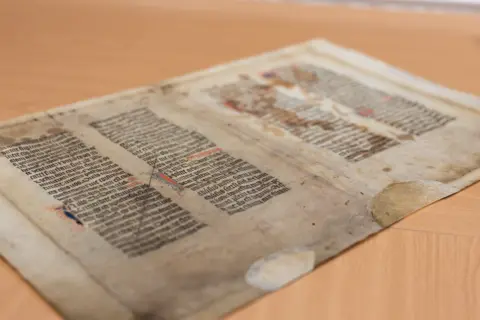
The team said many of the fragments were in Latin but six of them were in French, with most being popular works that survive in several copies across England and France.
One comes from a dramatic poem called L’Estoire de Griseldis, a secular play thought to have been written by Philippe de Mézières around 1395.
Versions of the Griselda story were popular across late medieval Europe but the version found in the Guernsey fragment was said by the team to be “exceptionally rare”.
Island archivist Vikki Hart said the reuse of the fragments as book covers showed resourcefulness “is nothing new in Guernsey”.
“What was once a practical act of reusing old parchment has, centuries later, preserved pieces of the island’s history that would otherwise have been lost,” she said.
Follow BBC Guernsey on X and Facebook and Instagram. Send your story ideas to channel.islands@bbc.co.uk.
Original source: https://www.bbc.com/
