

Ireland’s small but determined wine industry warming up

 Getty Images
Think about drinks produced in Ireland and you’d probably picture a creamy pint of stout or a tumbler of amber whiskey.
The last thing you’d probably think of is a glass of wine.
However, the Republic of Ireland is recognised as a wine producing country by the European Commission.
While it still has only a handful of commercial vineyards, along with smaller growers experimenting with wine production, the amount of land being planted with vineyards is continuing to grow.
A new winery near Slane in County Meath is believed to be the biggest ever planting of vines in Ireland – about 36,000 vines on 30 hectares of land.
‘We really are the extreme’
David Llewellyn is one of Ireland’s original winemakers, first becoming involved in the late 1980s, planting “a few dozen different vines” and observing “which ones were potentially viable”.
He established Lusca vineyard in County Dublin in 2002, and currently produces 1,500 to 2,000 bottles per year.
He said for many people Irish wine “is a curiosity, it’s a novelty”.
Llewellyn said the two varieties he “swears by “are a red called rondo and a white called Madeline Angevine.
“There are very few varieties of grape that can be grown reliably here in Ireland,” he said.
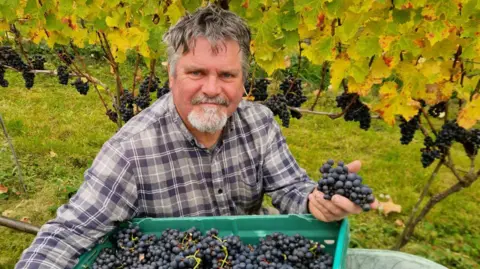 David Llewellyn
He said while comparisons are sometimes made between viticulture in Ireland and the UK, they are very different.
“It’s less marginal than we are, we are really the extreme,” he said.
“They can grow all kinds of varieties in England we just cannot grow here in Ireland – some of the classics like pinot noir and chardonnay.
“In Ireland we don’t have a hope at all of growing those grapes, but unfortunately people are planting them.”
Llewellyn said he tries to meet new winemakers in Ireland to pass on his knowledge.
“Anybody can do what I’m achieving if they do it right and plant the right varieties in the right type of location and if they have the skills and knowledge,” he said.
 David Llewellyn
Further south, in County Waterford, David Dennison started his Viking Winery in 2009, planting 30 vines of rondo.
He now has three and a half hectares producing 14 different varieties – red, white and ‘pet nat’ sparkling wine.
All are hybrids – crossbred varieties created by combining two or more distinct grape species.
“We think there’s a great future in hybrids,” he said.
“The flavours you get from the wines are just spectacular.”
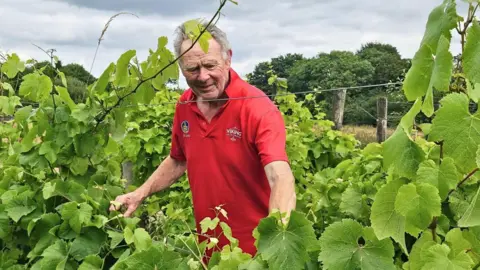 David Dennison
He added: “We’re certified organic, we don’t use sprays, using hybrids we don’t need sprays, because they’re disease resistant so they’re very, very good for our climate.”
“When these wines come into fashion, you get more and more producers producing them, I think the public will start to say ‘that’s different’.
“But it’s a long journey, we’re only at the beginning.”
He said the winery usually produces 2,500 to 3,000 bottles per year.
“I think this year we’re maybe going to hit 4,500,” he said.
“If we had our vines in full production now we could be up to about 15,000 bottles, that’s what we’re trying to work towards.”
Dennison said he follows the wine industry in Sweden and Denmark more than the UK “because they’re doing exactly what I think we’re going to do”.
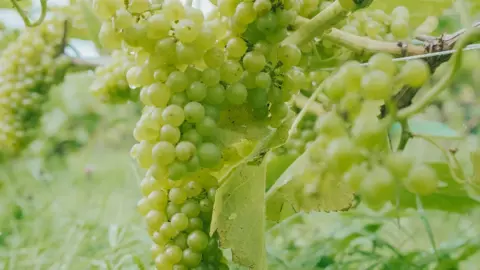 David Dennison
He said grapes are like any other Irish crop “everything really depends on the weather”.
“In the spring our biggest threat is frost, we have to put out burners and candles and everything to try and fight off the frost because if we don’t we lose the early crop, we lose the white.”
Dennison is setting up an Irish winemakers’ association, with just under 30 potential members.
Last weekend, The Irish Times reported that a large winery in County Louth has been dropped by a distributor as its labelling didn’t reflect that some French grapes had been used in its production.
Dennison said all winemakers would be invited to join the association “if they adhere to the rules”.
Will climate conditions become more favourable?
Climate change expert Prof John Sweeney said he is “not too surprised we now have vineyards in Ireland and it’s probably going to become more viable as our summer temperatures increase further.
“Viticulture benefits from relatively dry summers and again the models are predicting summers will become drier in Ireland,” he said.
 John Sweeney
He said the vineyards currently operating in Ireland tend to be on the east coast on relatively free-draining soils and sandier soils.
“I don’t think it’s going to be something that spreads very quickly,” he added.
“But the way global temperatures and Irish temperatures are going anything is possible by the end of the century.”
While he said viticulture was unlikely to spread to the west and north west, parts of Northern Ireland could become viable.
“Around Dundrum and those kind of sandy soil areas would possibly be candidates,” he said.
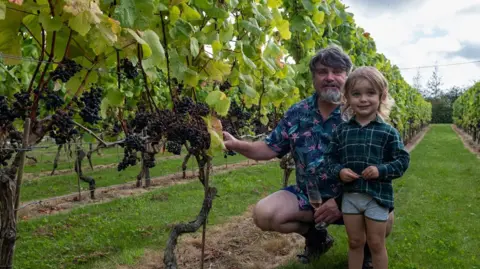 David Llewellyn
Looking to the future, David Llewellyn said he hopes the industry continues to grow in a sensible way, rather than people producing “a whole load of substandard wines”.
“It’ll be taken seriously if it’s done right and if the wine is good,” he said.
He warned that the production of what he termed “fake Irish wine” is the biggest threat to the industry’s credibility.
David Dennison said a lot of people “don’t even know about” the Irish wine industry.
“They haven’t been exposed to it, but they will when we get our act together,” he said.
“There’s not enough of it, that’s the problem.”
Original source: https://www.bbc.com/
