

Eight of the world’s most colourful buildings

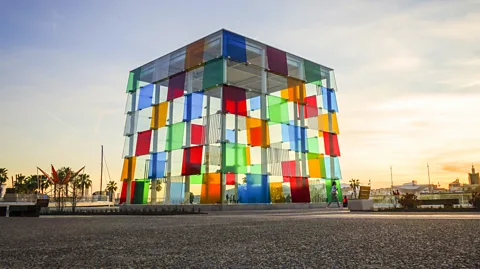 Pompidou Centre, Malaga/ Getty Images
Imaginative architects have long used colour to elevate their work. From a dazzling ancient temple to a vibrant library, here are eight buildings where colour is integral.
We have been using colour to bring joy for hundreds of thousands of years. Early Neanderthals decorated cave walls with pigments from the earth. These early efforts were followed by the polychromatic temples of ancient Egypt and Greece, and the structures of multi-coloured marble of ancient Rome. Throughout these eras, and wherever you looked, colour was on the agenda.
It has played a starring role in the stained glass of medieval churches, and on the frescoed ceilings and walls of the Italian Renaissance. And it has been integral to the bright and shiny surfaces of the late 20th and 21st Centuries, including the cube entrance to the Pompidou Centre, Malaga by Daniel Buren (pictured above), a symphony of colour and light.
Colour is “the crucial ingredient that elevates a building to otherwise unachievable heights of resonance and delight,” according to designer Adam Nathaniel Furman and author Kate Mazade, in Chromatic Architecture – the Crafts of Colour in Design.
Here are eight colourful structures from their new book. These vivid buildings are a call for architects to wield colour with more verve, and for us to open our eyes to what colour can make possible.
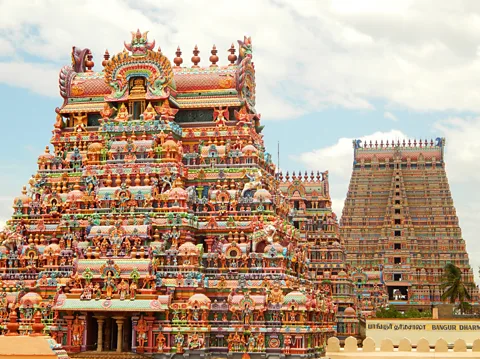 Rupesh Maurya/ Creative Commons
1. Sri Ranganatha Swamy Temple, Tamil Nadu, India
The southern state of Tamil Nadu in India is known for its ancient tradition of using colour. Building work of this temple started in the 1st Century AD and continued through multiple dynasties into the late 20th Century. The result is one of the world’s largest religious complexes of more than 150 acres.
It’s guarded by 21 gateways or gopurams, whose three-dimensional elements are decorated in bright pigments. “This site teems with a hyper-abundance of spiritual life that is made viscerally manifest through the beautiful use of pigments, which act to draw the visitor and worshipper out of the everyday, and into the realm of contemplation and wonder,” Furman tells the BBC.
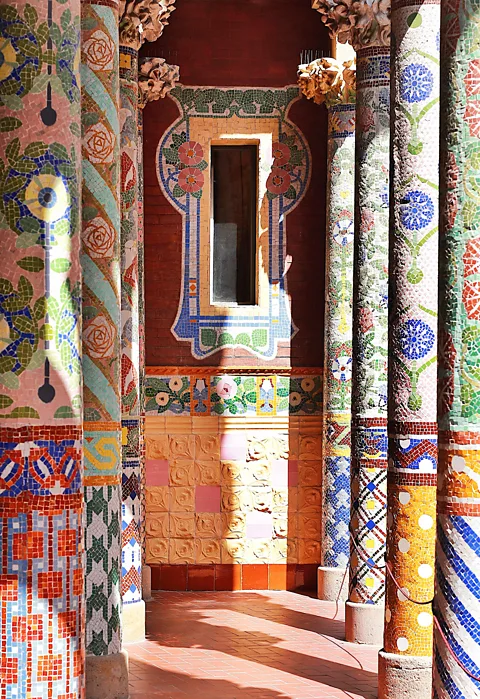 Photo Consuelo Borroni/ Pexels
2. Palau de la Música Catalana, Barcelona, Spain
The look of this 1908 concert hall came to embody the fast-industrialising, wealthy and culturally distinct Spanish region of Catalonia. Designed by Lluís Domènech i Montaner, the architecture mixes influences from Art Nouveau, the Romanesque and the Gothic Revival, alongside Moorish motifs and Valencian traditions.
For Furman, every single aspect of the Palau vibrates with symbolism, and wouldn’t be out of place in a fairytale forest. “Every piece of stone, baluster, voussoir, column and column capital, light sconce and handle are saturated in colour and decorative form that breathe life into them as if by magic,” he says.
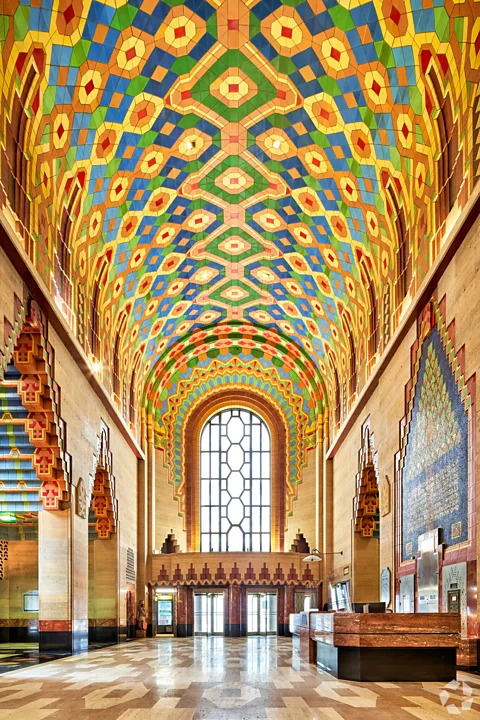 Guardian Building
3. Guardian Building, Detroit, Michigan, US
Locals know this 1929 office building by Wirt C Rowlandas as the “Cathedral of Finance”. It’s also one of the world’s most significant Art Deco skyscrapers.
“Rowland used colour in here as a way to showcase the breadth of craftsmanship in the US’s Great Lakes region in the early 20th Century,” Mazade tells the BBC.
The outside is covered in nearly two million orange-tinged bricks and terracotta tiles. Meanwhile inside, the main lobby has a three-storey vaulted ceiling, covered in a “quilt” of primary-colour tiles inside.
“The building was a bold statement of Detroit’s commercial success at that time, and serves as an ebullient reminder today,” she adds.
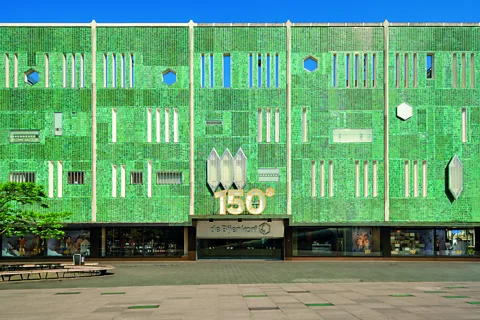
4. De Bijenkorf department store, Eindhoven, Netherlands
Reports have it that the Italian architect, designer and artist Gio Ponti drew inspiration from the lush, variegated grid of Dutch farmland seen from an aeroplane window for this 1969 design. Making this big, windowless building appealing could have been a challenge for many architects – but not for Ponti, who contributed to Modernism as much as Le Corbusier and Mies Van Der Roh.
He transformed it into “a vast, glittering field of emerald wonder,” Furman says. And in doing so, “he turned the typical nightmare blank concrete elevation of the period into a veritable masterpiece of modern art for the city”.
 Reversible Destiny Foundation
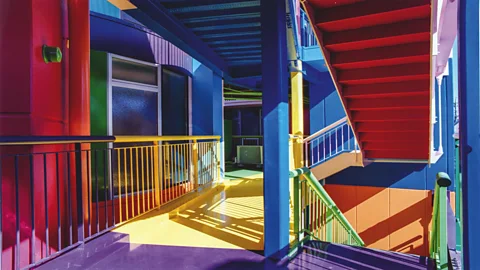
5. Reversible Destiny Lofts, Tokyo, Japan
This 2005 rental scheme was designed in memory of the US disability advocate and writer Helen Keller. The book describes the nine lofts by Shusaku Arakawa and Madeline Gins as a futuristic bricolage of brightly hued cylinders, cuboids, spheres and modern building elements. They come together into an all-enveloping alternative living environment whose every surface and accoutrement vibrates with colourful intensity.
The artist Arakawa and poet Gins wanted their choice of colours to unbalance the residents. “They believed that if an environment invigorated people out of their sedentary, domestic lifestyles, people could live longer,” Mazade explains. They combined undulating floors with spherical rooms, adorning them in a colour palette that is a radical, sensory overload for the supposed benefit of the occupant, she adds.
 HU-NET Corporation, Osaka
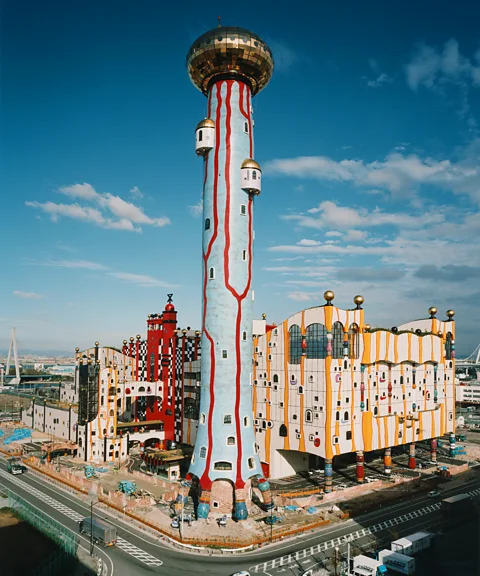
6. Maishima Waste Incinerator Plant, Osaka, Japan
Austrian visual artist and architect Friedensreich Hundertwasser died in 2000, a year before his building was completed. He was known for boycotting the flat regularity of Modernism and advocating for architecture as an evolving organism, rather than as a machine for fulfilling narrowly defined functions, the book explains.
For Hundertwasser, this applied to industrial buildings as much as it did to housing. The Maishima plant looks like an outlandish, Dr Zeuss-style castle, and is often mistaken for a nearby amusement park. The yellow “hand-drawn” stripes appear to drip down its low-rise elements, while its elongated cylindrical tower boasts similar stripes in red. All the structures in this complex, including the cantilevered element, stand on squat rounded legs decorated in blocks of colour.
Every part of this structure is about rebellion, Mazade says. “A garbage facility with an aqua chimney stack, chequerboard walls, sunflower and scarlet stripes – what’s more rebellious than that?”
 Roland Halbe
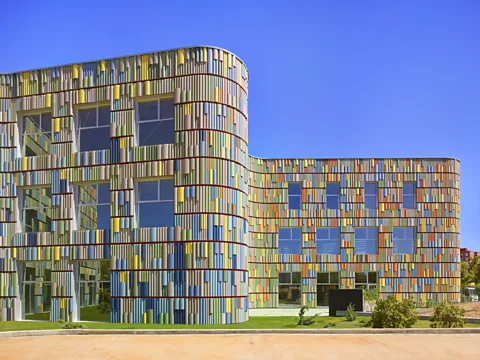
7. Leganés Central Library, Leganés, Spain
Built in 2019, this public library and municipal archive by BN Asociados Arquitectos is a visual metaphor of its contents. The bulbous façade of large-format pastel ceramics cling to the building’s rounded sides, alerting locals to the quantity and variety of books shelved inside.
This treatment also creates an urban icon in a new neighbourhood of Madrid, which was lacking cultural landmarks. “As sunlight moves across the scalloped ceramics, the soft pastels and matte texture create an effect almost like paper,” Mazade says.
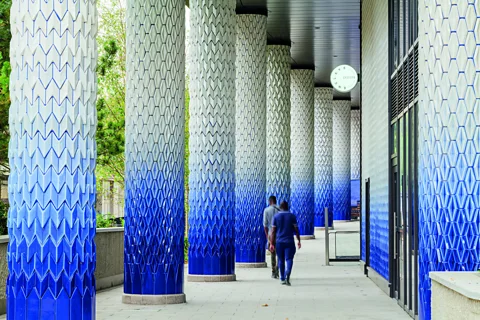 Gareth Gardner
8. Croydon Colonnade, London, UK
This 50-metre space for pedestrians in the architecturally challenged town of Croydon is made up of 16 giant columns and two big walls. The 2003 structure by Adam Nathaniel Furman is clad in thousands of three-dimensional, handmade porcelain tiles. And each of these tiles is coated in a rich, thick, translucent glaze. The base is a deep subaqueous blue, fading to a creamy white at the top.
This project is about bringing colourful high points from different times and places to East Croydon’s train station.
“The colour acts to immerse the passerby in a rich, sensuous environment. It recalls millennia of architectural ceramics in blue and white used in monumental buildings all over the world, from ancient Egypt, to Portugal, Turkey, Safavid Iran, Babylon and many other places,” its designer Furman says.
Chromatic Architecture – the Crafts of Colour in Design by Adam Nathaniel Furman and Kate Mazade is out on 1 September 2026.
—
If you liked this story, sign up for The Essential List newsletter – a handpicked selection of features, videos and can’t-miss news, delivered to your inbox twice a week.
Original source: https://www.bbc.com/
