
‘Chest-thumping machismo’: The Bayeux Tapestry reveals the bloody, bawdy truth about the Middle Ages

‘Chest-thumping machismo’: The Bayeux Tapestry reveals the bloody, bawdy truth about the Middle Ages

 Alamy
AlamyIn the 11th-Century masterpiece’s tale of a contested throne, about to be exhibited in the UK, virility is equated to power – and the largest and proudest appendage. It tells a story that feels familiar today.
The Bayeux Tapestry tells a bloody − and occasionally bawdy − story of the Norman conquest of England. The intricate masterpiece is embroidered on to 70 metres (77 yards) of flax linen, and weaves a tale of broken promises, greed and aggression that culminates in the death of King Harold II at the Battle of Hastings.
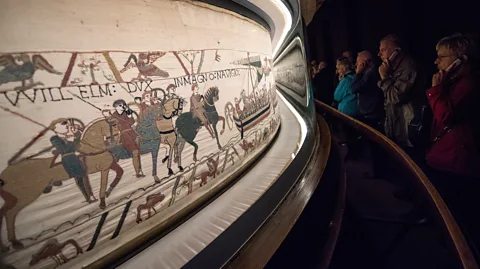
After almost 1,000 years, the iconic artwork is returning from Normandy, France to England, where it was skilfully stitched in the 1070s, and from this September is to be exhibited at the British Museum.
It’s an artwork depicting a medieval version of today’s digital manosphere: an ideology and world centred on hypermasculinity and men’s experiences. And a world where size matters.
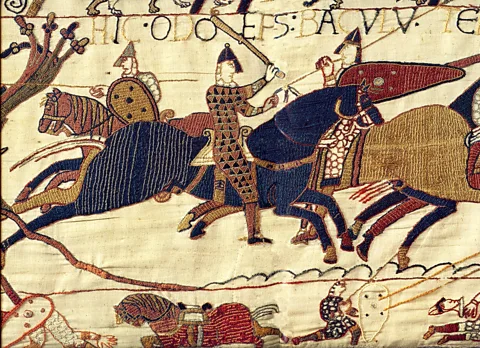
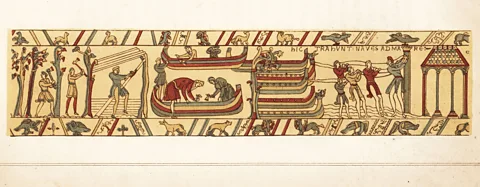
It is men’s contributions that form the focus of the 11th-Century society the tapestry portrays. A third of its men are armed, while others are vigorously engaged in tree-felling, boatbuilding and construction. A woodcutter straddling a length of timber readies his axe, while hunters wave large clubs about their heads as they pursue their quarry. “A more testosterone-soaked scene is hard to find,” Dr Christopher Monk, a cultural historian of medieval England, comments.
This suggestive display of chest-thumping machismo reveals a medieval society made for and by men, where violence settles disputes and laddish humour scores political points. Armed pillagers rampage through Hastings, and fallen soldiers in the lower margin are stripped nude for their armour, just as Harold, slain above them, is denuded of his royal claim. All of this helps communicate the heightened atmosphere of an impending confrontation between two alpha males: William, Duke of Normandy and Harold Godwinson.
The recurring penis
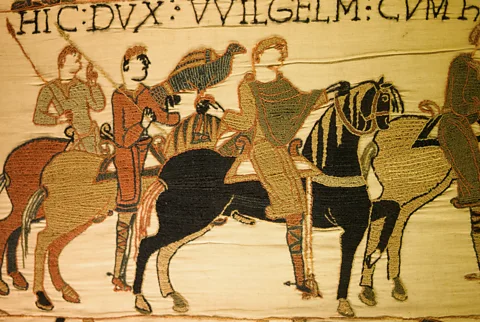
If there’s a recurrent motif in the iconic artwork, it’s the penis. In 2018, George Garnett, professor of medieval history at Oxford University in the UK, counted 93 – mostly tumescent – specimens in the embroidery. Eighty-eight belonged to horses, and another five to men, with a pendulous scabbard (which he rules out) causing considerable debate in academic circles.
The use of male genitalia, be it human or equine, is shorthand for political machismo – Dr Christopher Monk
“Size matters on the Bayeux Tapestry,” observes Janina Ramirez in Femina: A New History of the Middle Ages, Through the Women Written Out of It (2022). In the tapestry’s tale of a contested throne, virility is equated to power and the largest and proudest appendage, she notes, “belongs to the fine stallion William is presented with on the eve of the battle”. Second place goes to King Harold’s mount, “the implication being that he is a worthy opponent”.
 Alamy
AlamyWithin the traditions of 11th-Century art, graphic nudity was commonplace, and it’s quite possible that these penises were stitched by nuns. “They reflect what was so evident more broadly in elite medieval society – by and large, men were the primary drivers of political sovereignty,” Monk tells the BBC. “The use of male genitalia, be it human or equine,” he says, is “shorthand for the political machismo within the context of the transition to the new Anglo-Norman world in medieval England.”
If women play a minor role in the tapestry, it’s primarily because “the narrative revolves around male action”, Dr Emily Joan Ward, a lecturer in medieval history at Edinburgh University in the UK, tells the BBC. “It’s largely depictions of militarily active men, and in those battle scenes we wouldn’t expect women.”
If a ratio of one to 100 still seems unbalanced, there may be a clue in who the artwork was intended for. Historians believe the tapestry’s likely patron is William’s half-brother, the Bishop Odo of Bayeux, who features prominently in it and may have used the tapestry to emphasise his important role in the campaign for William’s rightful rule.
 Alamy
Alamy“The content is probably to resonate with him and his immediate social circle, which will largely be a homosocial circle of men,” says Wade. With a Norman sponsor, the messaging needed to be on brand. “Introducing too many women into the story is actually a bit risky,” she adds. “William’s attempts to stress his legitimacy to the throne through the female line may have made the designer or patron wary of drawing attention to this tenuous claim.”
The six women in the tapestry
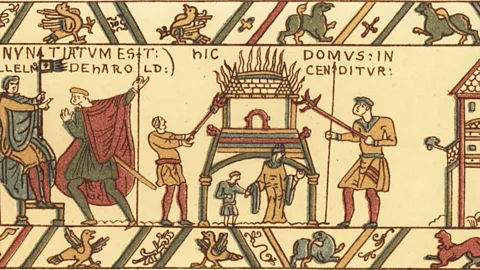
The women in the central story mostly serve as what Monk calls “emotional punctuation”. Queen Edith, a highly influential figure in court politics, mops her tears with her scarf as her husband, Edward the Confessor, takes his final breaths; and a woman and her child flee as gigantic Norman soldiers casually torch their home. Bizarre expressions and proportions aside, it’s a scene that reminds us, says Ward, “that warfare is not just a male-dominated event, not just what’s happening on the battlefield.”
She references the historian Catherine Karkov, who observes that the women in the main register appear at moments of shifting power relations. “If we interpret it that way,” Ward remarks, “it gives them quite a powerful role in the tapestry.”
 Alamy
AlamyThe decorative borders above and below the tapestry take us into a world that is more subversive due to its coded critique of the central characters, often in the form of fables. It’s here that three of the women appear.
In the lower border, a woman recoils from a sexual aggressor, thought to be her father. Later, in the upper border, two nude women gesticulating towards naked men are thought to be associated with stories of a seductress and a prostitute who used their bodies to deceive, hinting at Harold’s broken oath.
We’re missing William’s daughter, Agatha of Normandy, who was offered to Harold in part-exchange for the crown. Ward notes that we’re shown William’s impressive flagship, the largest and fastest vessel in the Norman fleet named the Mora, but we do not see his formidable wife, Matilda of Flanders, who paid for the ship in order to facilitate the military success that would make her Queen.
‘Medieval Me-Too moment’
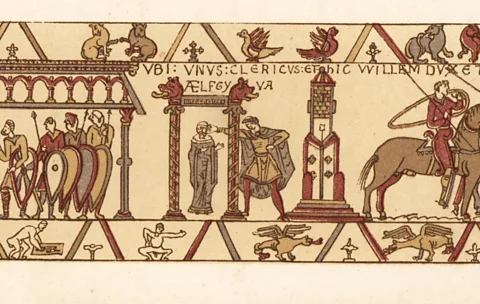
One mysterious cloaked figure does however get a namecheck: Aelfgyva. A seemingly predatory priest in a green cape reaches for her face, while in the border, a naked man with impossibly large genitals mimics his pose. Proposals for who she is and why she is there are manifold. The suggestion of Dr David Musgrove, co-author of The Story of the Bayeux Tapestry (2026), that sexual harassment by the priest is being called out in “a medieval Me-Too moment” makes sense.
 Getty Images
Others have been more dismissive. As one 20th-Century historian commented: “since it contributes nothing to the story, except a moment of confusion, we have felt justified in leaving it out”.
[The embroiderers] were no doubt working to a design but that does not mean that they were merely executors of another’s will – Dr Chirstopher Monk
Just as monks inserted illustrations in the margins of manuscripts, it’s possible that female embroiderers were permitted a little creative liberty with these cryptic comments on the central story. “They were no doubt working to a design,” Monk tells the BBC. “But that does not have to mean that they were merely executors of another’s will, or indeed that every detail was dictated.”
Perhaps in the border, the invisible women behind the artwork had the last laugh. “Was it a way of expressing despair at bellicose men, or at their own plight as subjugated English women? Is there any sense of mockery, particularly of William? Or were they indulging in playful, earthy humour to pass the time?” Monk asks.
“It’s impossible, perhaps, to answer these questions, but it should at the very least make us reflect on the fact that the Bayeux Tapestry only exists because of the skilled and intelligent labour of women.”
 Getty Images
It was Victorian sensibilities that would eventually subdue some of the original tapestry’s machismo. In a faithful replica, created in 1885 by a group of 35 women belonging to the Leek Embroidery Society (currently on display at Reading Museum), the advancing armies are still full of men, but the horses’ oversized members have retreated. Unsurprisingly, the naked man with the outsized genitals who was mimicking the priest in the border is shown in more realistic proportion.
More like this:
Most importantly though, by introducing an additional border where each embroiderer stitched her name, the 1885 version honoured its creators and asserted a female presence. As Ramirez points out: “While no one would think of discussing Starry Night without mentioning Van Gogh… very few begin discussions of the Bayeux Tapestry thinking about the women who made it.”
A manosphere, be it modern or medieval, might tell stories of male power, but its existence may be dependent on the women it tries to leave out.
The Bayeux Tapestry is at the British Museum, London from 10 September to 11 July 2027. The 1885 version is on permanent display at Reading Museum.
—
If you liked this story, sign up for The Essential List newsletter – a handpicked selection of features, videos and can’t-miss news, delivered to your inbox twice a week.
Original source: https://www.bbc.com/
