
Lung cancer remains one of the most commonly diagnosed and life-threatening cancers worldwide. Accurate documentation, classification, and coding play a critical role in patient care, billing, research, and healthcare analytics. This is where the ICD-10 system becomes essential. Understanding ICD 10 for Lung Cancer helps healthcare providers ensure precise diagnosis reporting and proper treatment planning.
Understanding Lung Cancer and Its Clinical Importance
Lung Cancer occurs when abnormal cells grow uncontrollably in the lungs. It is broadly divided into two major types: non-small cell lung cancer (NSCLC) and small cell lung cancer (SCLC). These categories influence treatment decisions and prognosis, making accurate diagnosis and coding extremely important.
Risk factors include smoking, exposure to secondhand smoke, environmental pollutants, and genetic predisposition. Early diagnosis can significantly improve survival rates, which is why standardized coding systems like ICD-10 are vital for tracking and managing the disease.
What Is ICD 10 and Why It Matters
The ICD-10 system, developed by the World Health Organization, is used globally to classify diseases and health conditions. It provides a structured format for recording diagnoses, symptoms, and medical procedures.
For lung cancer, ICD-10 codes help in:
Accurate medical billing and insurance claims
Standardized communication between healthcare providers
Clinical research and statistical analysis
Monitoring disease trends and public health planning
Without proper ICD-10 coding, there can be errors in treatment records, reimbursement delays, and gaps in healthcare data.
ICD 10 for Lung Cancer Codes Explained
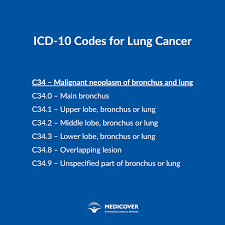
The primary ICD 10 for Lung Cancer falls under the category C34, which represents malignant neoplasms of the bronchus and lung. These codes are further divided based on the specific location within the lung.
Here are the key ICD-10 codes used:
C34.0 Malignant neoplasm of main bronchus
C34.1 Malignant neoplasm of upper lobe, bronchus or lung
C34.2 Malignant neoplasm of middle lobe, bronchus or lung
C34.3 Malignant neoplasm of lower lobe, bronchus or lung
C34.8 Malignant neoplasm of overlapping sites of bronchus and lung
C34.9 Malignant neoplasm of unspecified part of bronchus or lung
Each code provides a more precise description of where the tumor is located, which is essential for treatment planning and documentation.
Importance of Accurate Coding in Lung Cancer Diagnosis
Using the correct ICD 10 for Lung Cancer ensures that the patient’s condition is properly recorded. Inaccurate coding can lead to several issues, such as:
Incorrect treatment decisions due to incomplete medical data
Insurance claim rejections or delays
Misrepresentation in healthcare statistics and research
Legal and compliance risks for healthcare providers
For example, coding a tumor as C34.9 (unspecified) instead of a specific lobe may result in loss of critical clinical detail. Precision is always preferred.
How Lung Cancer Is Diagnosed
Before assigning an ICD-10 code, a confirmed diagnosis is necessary. Diagnosis typically involves a combination of:
Imaging tests such as chest X-rays, CT scans, and PET scans
Biopsy procedures to examine lung tissue
Sputum cytology for detecting cancer cells
Bronchoscopy to view the airways
Once the cancer is confirmed, the physician determines the exact location and type, which directly influences the ICD-10 code selection.
Staging and Its Role in Coding
Although ICD-10 codes focus on the location of the tumor, staging is another critical component in lung cancer management. Staging describes how far the cancer has spread and is usually classified using the TNM system (Tumor, Node, Metastasis).
While staging itself is not included in ICD-10 codes, it complements the diagnosis and helps clinicians decide on treatment options such as surgery, chemotherapy, radiation, or targeted therapy.
Common Challenges in ICD 10 for Lung Cancer Coding
Despite the structured system, coding lung cancer can be challenging due to:
Incomplete clinical documentation
Unclear tumor location
Multiple tumor sites
Overlapping lesions
Healthcare providers must rely on detailed medical records to assign the most accurate code. Coders often need to review pathology reports, imaging findings, and physician notes to ensure precision.
Best Practices for Accurate Coding
To improve accuracy in ICD 10 for Lung Cancer coding, healthcare professionals should follow these best practices:
Ensure detailed documentation of tumor location and type
Avoid using unspecified codes unless absolutely necessary
Stay updated with ICD-10 coding guidelines
Collaborate closely between clinicians and medical coders
Review patient records thoroughly before finalizing codes
These practices not only improve coding accuracy but also enhance overall patient care and data reliability.
Role of ICD-10 in Treatment and Research
ICD-10 codes are not just for administrative purposes. They play a significant role in clinical research and treatment advancements. Researchers use coded data to:
Identify trends in lung cancer incidence
Evaluate treatment outcomes
Develop new therapies and drugs
Improve public health strategies
Accurate coding ensures that research data is reliable and meaningful, ultimately benefiting patients worldwide.
ICD 10 Updates and Future Trends
The healthcare industry continuously evolves, and so does the ICD system. Updates may include more specific codes, improved classification, and better integration with digital health systems.
With advancements in precision medicine and artificial intelligence, future coding systems may become even more detailed, allowing for personalized treatment approaches and enhanced data analytics.
Conclusion
Understanding ICD 10 for Lung Cancer is essential for healthcare providers, medical coders, and researchers. Accurate coding ensures proper diagnosis documentation, effective treatment planning, and seamless healthcare operations.
By using the correct ICD-10 codes, professionals can improve patient outcomes, streamline billing processes, and contribute to global health data accuracy. As lung cancer continues to be a major health concern, the importance of precise coding cannot be overlooked.
Frequently Asked Questions (FAQ)
What is the main ICD 10 code for lung cancer
The primary ICD-10 code for lung cancer is C34, which covers malignant neoplasms of the bronchus and lung. It is further divided into subcategories based on tumor location.
Why is ICD 10 for Lung Cancer important
It ensures accurate diagnosis documentation, proper billing, and effective communication among healthcare providers while supporting research and public health data.
What does C34.9 mean in ICD-10 coding
C34.9 refers to a malignant neoplasm of an unspecified part of the bronchus or lung. It is used when the exact location is not documented.
Can ICD-10 codes determine the stage of lung cancer
No, ICD-10 codes identify the location of the cancer, not its stage. Staging is determined separately using clinical systems like TNM.
Who uses ICD 10 for Lung Cancer codes
Healthcare providers, hospitals, medical coders, insurance companies, and researchers all use ICD-10 codes for documentation, billing, and analysis.
How can coding errors be avoided
Accurate clinical documentation, proper training, and careful review of patient records can help reduce errors in ICD-10 coding.
Is ICD-10 used worldwide
Yes, the ICD-10 system is used globally, although some countries may have modified versions for local use.
What happens if the wrong ICD-10 code is used
Incorrect coding can lead to claim denials, treatment delays, and inaccurate medical records, which can impact patient care and healthcare data quality.
By mastering ICD 10 for Lung Cancer, healthcare professionals can ensure accuracy, efficiency, and better outcomes in both clinical and administrative processes.