
Type 2 diabetes is one of the most common chronic conditions worldwide, affecting millions of people across different age groups. As healthcare systems continue to digitize and standardize patient data, medical coding plays a crucial role in ensuring accurate diagnosis, treatment, and billing. One of the most important coding systems used globally is the ICD-10 system. In this article, we will break down the ICD 10 Code for Type 2 Diabetes in a simple, clear, and practical way so that even non-medical readers can understand it easily.
What is ICD-10 and Why It Matters
ICD-10 stands for the International Classification of Diseases, 10th Revision. It is a coding system developed by the World Health Organization (WHO) to classify diseases, symptoms, and medical conditions. Doctors, hospitals, insurance companies, and researchers use these codes to document diagnoses and streamline healthcare processes.
The use of ICD codes ensures that everyone in the healthcare system speaks the same language. Whether a patient is treated in India, the United States, or Europe, the coding system helps maintain consistency in diagnosis and treatment records.
Understanding Type 2 Diabetes
Before diving into the codes, it’s important to understand what Type 2 diabetes actually is. This condition occurs when the body becomes resistant to insulin or when the pancreas does not produce enough insulin. As a result, blood sugar levels rise, leading to various health complications if not managed properly.
Unlike Type 1 diabetes, which is usually diagnosed in childhood, Type 2 diabetes often develops later in life and is strongly linked to lifestyle factors such as diet, physical activity, and obesity.
ICD 10 Code for Diabetes and Its Structure
When people search for “icd 10 for diabetes,” they are usually looking for the general classification of diabetes within the ICD-10 system. Diabetes mellitus falls under the category E08 to E13. Each category represents a different type or cause of diabetes.
Here is a quick overview of the diabetes categories:
E08 Diabetes mellitus due to underlying condition
E09 Drug or chemical induced diabetes mellitus
E10 Type 1 diabetes mellitus
E11 Type 2 diabetes mellitus
E13 Other specified diabetes mellitus
For Type 2 diabetes specifically, the main code used is E11.
ICD 10 Code for Type 2 Diabetes
The base code for Type 2 diabetes is:
E11 Type 2 diabetes mellitus
However, this is just the starting point. ICD-10 coding is highly detailed, and additional digits are added to describe complications and conditions associated with diabetes.
For example:
E11.9 Type 2 diabetes mellitus without complications
E11.65 Type 2 diabetes mellitus with hyperglycemia
E11.22 Type 2 diabetes mellitus with diabetic chronic kidney disease
E11.40 Type 2 diabetes mellitus with diabetic neuropathy, unspecified
E11.319 Type 2 diabetes mellitus with unspecified diabetic retinopathy without macular edema
Each of these codes provides more specific information about the patient’s condition.
Why Specific ICD Codes Are Important
Using the correct ICD 10 code for diabetes is not just a technical requirement. It has real-world implications.
Accurate Diagnosis Documentation
Detailed coding helps doctors keep a precise record of a patient’s condition and monitor progression over time.
Insurance and Billing
Insurance claims rely heavily on ICD codes. Incorrect coding can lead to claim denials or delays.
Treatment Planning
Specific codes help healthcare providers understand the severity and complications of diabetes, leading to better treatment decisions.
Medical Research and Data
Researchers use ICD data to study disease patterns, prevalence, and outcomes across populations.
Common Complications and Their Codes
Type 2 diabetes is often associated with various complications, and ICD-10 codes reflect these in detail.
Diabetic Neuropathy
Nerve damage caused by high blood sugar levels is coded under E11.4 series.
Diabetic Retinopathy
Eye-related complications are coded under E11.3 series, depending on severity and presence of macular edema.
Diabetic Nephropathy
Kidney damage is coded under E11.2 series, often linked with chronic kidney disease.
Diabetic Foot Problems
Ulcers and infections related to diabetes may require additional codes alongside E11.
Hyperglycemia and Hypoglycemia
High and low blood sugar levels are also specified with distinct codes like E11.65.
How Doctors Choose the Right Code
Selecting the correct ICD 10 code for diabetes involves several steps.
Reviewing the Patient’s Medical History
Doctors assess the type of diabetes and any existing complications.
Identifying Current Symptoms
Symptoms such as high blood sugar, nerve pain, or vision issues guide code selection.
Checking Lab Results
Blood glucose levels, HbA1c, and other tests confirm the diagnosis.
Applying Coding Guidelines
Healthcare providers follow official coding guidelines to ensure accuracy.
Difference Between E11.9 and Other E11 Codes
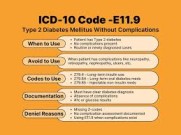
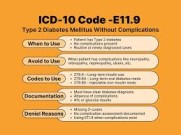
One of the most commonly used codes is E11.9, which stands for Type 2 diabetes without complications. This code is used when a patient has diabetes but no documented complications.
However, if a patient has any related condition such as neuropathy, kidney disease, or retinopathy, a more specific code must be used instead of E11.9. Using a general code when a specific one is required can lead to inaccurate records and billing issues.
ICD 10 Coding Tips for Type 2 Diabetes
Use the Most Specific Code Available
Always choose a code that fully describes the patient’s condition.
Document All Complications
Every complication should be clearly recorded and coded.
Avoid Using Unspecified Codes
Codes like E11.9 should only be used when no additional details are available.
Stay Updated with Guidelines
ICD coding rules can change, so staying informed is essential.
Real-Life Example of ICD Coding
Let’s say a patient is diagnosed with Type 2 diabetes and also has chronic kidney disease.
Instead of using a general code like E11.9, the correct code would be:
E11.22 Type 2 diabetes mellitus with diabetic chronic kidney disease
Additionally, a separate code for the stage of kidney disease may also be required. This level of detail helps ensure proper treatment and billing.
Challenges in Diabetes Coding
Despite its importance, ICD coding can sometimes be complex.
Multiple Complications
Patients may have more than one complication, requiring multiple codes.
Incomplete Documentation
If medical records are not detailed enough, choosing the correct code becomes difficult.
Frequent Updates
ICD codes are periodically updated, which can create confusion.
Training Requirements
Healthcare professionals need proper training to apply codes accurately.
The Role of Medical Coders
Medical coders are trained professionals who specialize in assigning ICD codes. They work closely with doctors and healthcare providers to ensure that every diagnosis is coded correctly.
Their role is essential in maintaining the accuracy of patient records, facilitating insurance claims, and supporting healthcare analytics.
Future of ICD Coding
As healthcare continues to evolve, coding systems are also improving. The transition to newer versions like ICD-11 aims to provide even more detailed and user-friendly classifications.
Technology, including electronic health records and AI tools, is also making coding faster and more accurate.
Conclusion
Understanding the ICD 10 Code for Type 2 Diabetes is important for healthcare professionals, medical coders, and even patients who want to better understand their medical records. The keyword icd 10 for diabetes covers a broad category, but for Type 2 diabetes, the E11 code and its subcategories are the most relevant.
Accurate coding ensures better patient care, smoother insurance processes, and reliable medical data. While it may seem complex at first, breaking it down into categories and examples makes it much easier to understand.
Frequently Asked Questions (FAQ)
What is the ICD 10 code for Type 2 diabetes without complications
The correct code is E11.9, which indicates Type 2 diabetes mellitus without complications.
What does E11 mean in ICD 10
E11 is the category used for Type 2 diabetes mellitus in the ICD-10 system.
Why are there so many codes for diabetes
Different codes are used to specify complications and severity, making diagnosis and treatment more precise.
Can one patient have multiple ICD 10 codes for diabetes
Yes, if a patient has multiple complications, more than one code may be used to fully describe their condition.
What is the difference between E10 and E11
E10 is used for Type 1 diabetes, while E11 is used for Type 2 diabetes.
Is ICD 10 coding important for patients
Yes, accurate coding affects medical records, insurance claims, and overall quality of care.
How often are ICD codes updated
ICD codes are updated periodically to reflect new medical knowledge and healthcare practices.
Can incorrect coding affect insurance claims
Yes, incorrect or incomplete coding can lead to claim denials or delays in reimbursement.
What is the general icd 10 for diabetes category
Diabetes is categorized under E08 to E13 in ICD-10, covering different types and causes.
Do all healthcare providers use ICD 10
Most countries use ICD-10, although some are transitioning to ICD-11 for improved classification.
read more
https://cgstatus.in/whats-the-icd-10-code-for-asthma/
https://cgstatus.in/what-is-the-icd-10-code-for-lower-back-pain/
https://cgstatus.in/depression-icd-10-code-explained-for-accurate-diagnosis/
https://cgstatus.in/migraine-icd-10-codes-explained-for-healthcare-providers/
https://cgstatus.in/icd-10-code-for-pneumonia-accurate-diagnosis-guide/
https://cgstatus.in/icd-10-code-for-heart-attack-accurate-diagnosis-guide/
https://cgstatus.in/icd-10-code-for-anemia-complete-guide-for-accurate-coding/
https://cgstatus.in/icd-10-stroke-codes-complete-guide-for-accurate-diagnosis/