

How Australia combines modern tech and Indigenous knowledge to fight fire

 Getty Images
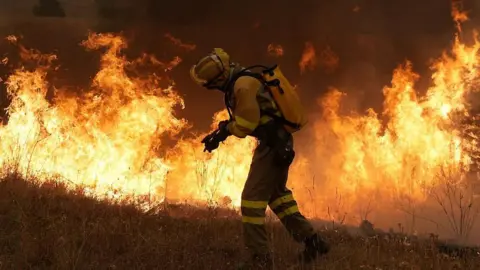
The wildfires currently ravaging Europe feel close to home for Professor Marta Yebra, despite being on the other side of the world.
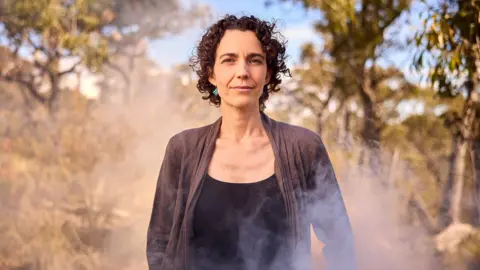
Originally from Spain, the Canberra-based bushfire expert has spent years developing ways for Australia – home to some of the most fire-prone landscapes in the world – to battle its own blazes.
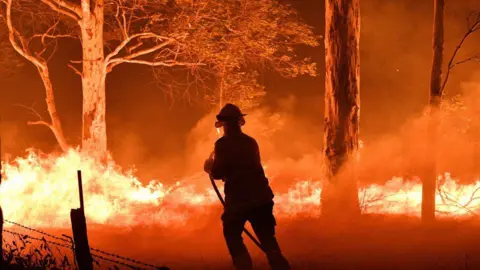
She heads up the Bushfire Research Centre of Excellence, which was set up in the aftermath of Australia’s worst fire season on record: the Black Summer fires of 2019-20, which razed a combined area about the size of the UK.
Her team looks at how technology such as satellites, drones and AI can be used to better detect fires, alongside the knowledge of experienced firefighters.
Equally important, though, is the knowledge and experience that has accrued in Australia over thousands of years, and has been passed down through generations.
This is where Australia has an advantage.
The use of fire has been part of the country’s Indigenous culture since long before Europeans arrived in the 18th century – but the value of this ingrained knowledge has only been truly realised in recent years.
From outer space to underground
Yebra has spearheaded an innovative project, bringing together millennia-old knowledge in Australia’s Indigenous communities with cutting-edge satellite imagery to help detect where fires are most likely to break out.
The satellite images pick up the “fuel moisture content” in the landscape, which signals where there might be a large amount of fuel, such as dry leaves, grass, shrubs and bark. But such data provides just one part of a bigger picture.
That’s where the likes of Adrian Webster come in.
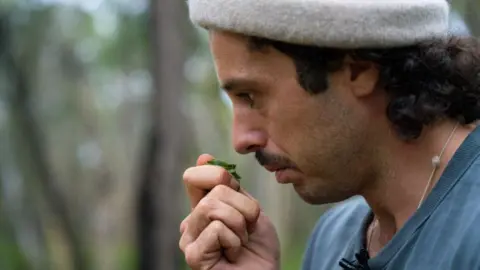
Growing up on the south coast of New South Wales (NSW), Webster learnt how to read the environment or “country” – the term Indigenous Australians use for their ancestral homeland – from his elders.
 Nic Vevers
Using Indigenous ecological knowledge – a plant’s colour and scent, for example, or the shade cover of trees – he can verify information in the satellite images from Yebra’s team.
“She had all this amazing data, but there was no translation to what it meant on the ground, so it was kind of useless,” he explains.
“But through an Indigenous perspective, it was not useless. It was a map that could guide you through the country and, if you understood it, take you directly into a place that is ready to burn.”
For Webster, assessing the land involves him “literally digging and going underground,” he says.
“We’re looking at the subsurface level and then everything from that up beyond the canopy.”
Yebra said there was a “remarkable agreement” between Webster’s local knowledge and the satellite data, demonstrating the combined value of Indigenous expertise and Western science.
Her team now hopes to get more funding for the project, and work with Indigenous communities to co-design plans to protect the land and manage fires.
For Webster, it’s about “allowing our mother – the planet Earth – a voice again”.
 Getty Images
Fire as friend, not just foe
Another example of ancient wisdom influencing modern techniques can be found in the way Australia fights fire with fire.
Cultural burning refers to a longstanding practice by Indigenous Australians to manage the environment while also maintaining a deep, spiritual connection to the land.
Part of it is lighting “cool fires”: small, controlled blazes that create a patchy landscape, so fuel does not build up in one area.
“In Europe, there is no such cultural aspect to this kind of landscape planning,” Yebra says.
Wildfire scientists in Spain have blamed a massive build-up of fuel for the blazes currently devastating the country.
“It is difficult to watch what is happening in Spain, but it is not surprising,” Yebra says. “Particularly as climate change is increasing the frequency of extreme fire weather across southern Europe.”
She believes Europe, facing its worst wildfires in decades, could benefit from Australia’s firefighting experience.
“We have decades of experience living with large and high-intensity bushfires,” she says. “One of the biggest changes we are seeing in bushfire management is a shift from simply reacting to fires towards anticipating risk and acting earlier.
“The earlier we can identify risk or detect an ignition, the more options firefighters have.”
 Nic Vevers
Webster says a key lesson the world could learn from Australia is “don’t sit back and wait”.
“The longer you leave it, the more fuel there is to burn, so the fire is naturally going to be bigger and harder to extinguish,” he says.
“Indigenous people always knew that, so we burnt continuously all the time. That way there was no fuel for big fires.”
The practice of lighting cool fires dates back 60,000 years. Part of Webster’s role is to assess the area before one is lit, looking for natural signs of oil and water in the landscape so that the blaze remains under control.
“All the answers are in the environment,” he says. “There’s a sweet spot in the middle where there’s enough water to slow that fire down but there’s enough oil to push that fire on.”
A more modern tactic used across Australia is a prescribed burn, also known as a hazard reduction burn. These carefully planned, often large-scale fires are usually carried out during cooler months, and are increasingly being adopted in parts of Europe.
It’s an approach that has become especially vital in the “urban fringes”, says superintendent Andrew Shurety from Fire and Rescue NSW.
As Australia’s population grows and suburbs expand, more people are moving closer to bushland, making hazard burns firefighters’ “main mitigating factor that we try to do to reduce the risk of bushfires because we know they’re going to come”.
The problem, Shurety points out, is that longer fire seasons and more rain during cooler months shortens the window that such burns can be carried out.
Starving a fire of fuel is also the idea behind “backburning”, a widely accepted practice in Australia where a blaze is deliberately lit ahead of a main fire to strip out the vegetation and try to stop it from spreading.
This approach is also being increasingly adopted overseas – as Queensland firefighter Damian Hatfield found out.
 Supplied
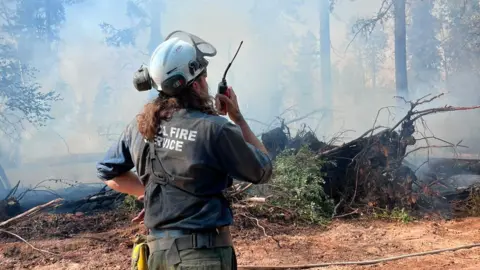
When he travelled to Alberta, Canada with a contingent of Australian firefighters to help tackle the country’s worst wildfires on record, backburning was not widely used. A year later, things had shifted.
“Backburning was definitely much more at the forefront when I returned in 2024,” he says, with Canadian firefighters showing “no hesitation” to include the approach in their operations.
Drones have also transformed how Australia deals with bushfires, says Trent Curtin, from the Rural Fire Service in NSW – particularly in recent years.
“The local crews arrive, send a drone up quickly, have a look at where the fire is and how it’s progressing, get some intelligence and make decisions before we can even get our large helicopters or other aircraft down,” Curtin explains.
Drones also deliver heavy gear to crews on the ground, start blazes for backburning operations and help assess the damage caused by fires.
The summer ahead
Back at Yebra’s centre, the team’s work is particularly timely with weather forecasters predicting a super El Nino this summer – which could increase the probability of extreme heat, drought and bushfires.
“Our next fire season is looking like it’s going to be a bad one,” Yebra says.
That concern is shared by Jason Heffernan, chief officer of the Country Fire Authority in Australia’s southeastern state of Victoria. Here, the memories of 2009’s Black Saturday bushfires – the country’s deadliest on record – loom large.
“For this summer coming, we’re bracing for what could be something extremely significant,” Heffernan says.
Even in the broader scheme of things, he notes that local fire seasons are starting earlier and lasting longer. “Unfortunately for Australia”, he adds, “our environment is designed to burn.”
But as the world braces for wildfires that are more frequent and intense, Heffernan also believes “we must take a global perspective”.
“No fire service can do this on their own and the key is to have formal and trusted networks,” he says – as well as national and international resource-sharing arrangements.
One of the challenges as a fire chief, he explains, is knowing when to ask for help – too late and the benefits will be lost, but too early and resources might be wasted.
Such a call was made just earlier this week, when France sent its first-ever request for help from Australian firefighters. Two dozen crew and several aircraft will be deployed as France battles record-breaking wildfires amid a prolonged summer heatwave.
Australia regularly sends specialist teams to the US and Canada, and vice versa, with many requests for what’s known as “arduous fire crews”: those who have fought fires in rugged and remote areas.
There are far fewer requests from Europe, Heffernan says – but this may change as “the global fire community is becoming more connected”.
As he points out, while forests and climates vary across the globe, “we’re seeing bushfires occur in parts of the world that never had bushfires before”.
Original source: https://www.bbc.com/