
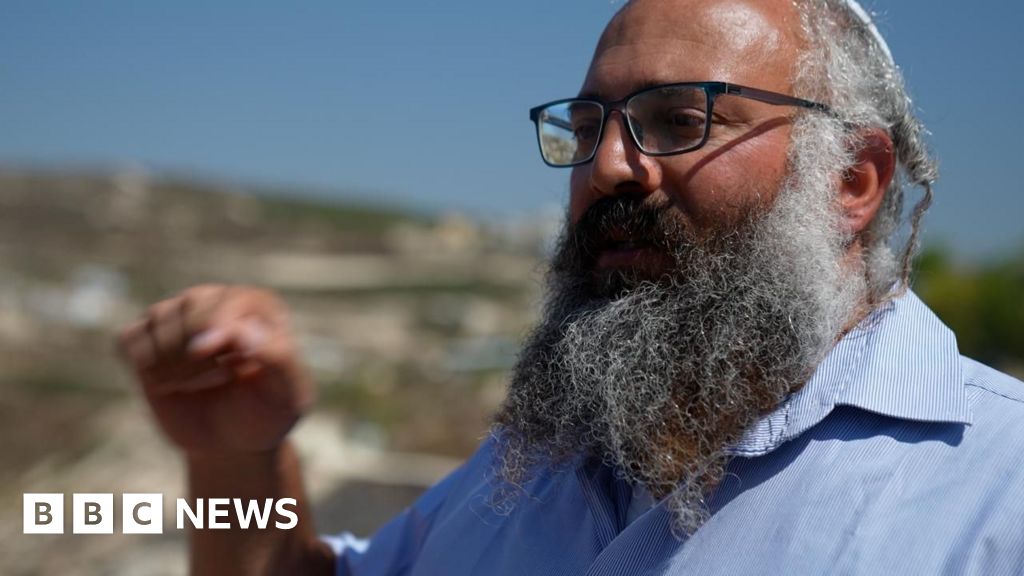

Israeli West Bank settler tells BBC attacks on Palestinians are justified as revenge
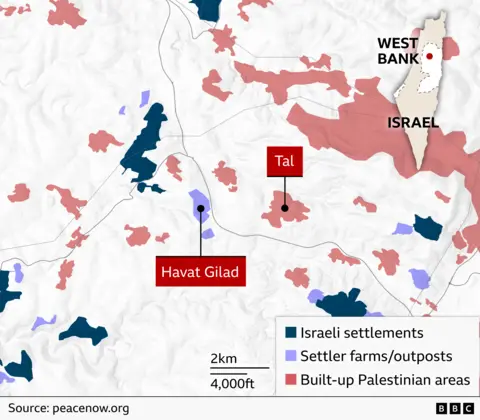
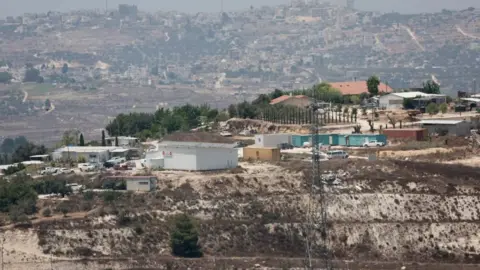
The Israeli settler outpost of Havat Gilad, deep inside the occupied West Bank, is spread across several hilltops, its sheds and simple block houses clearly visible from neighbouring Palestinian villages.
Last weekend saw a wave of settler attacks on Palestinian villages in the area, after an Israeli security guard from Havat Gilad was killed during a confrontation between Palestinians and Israelis in the village of Tal last Friday.
Four Palestinians and an Israeli soldier were also killed in the incident, the original cause of which is disputed.
After spending the weekend speaking to Palestinians around Havat Gilad, we drove into the outpost itself, to ask one of its residents about the violence, and the expansion of Israeli settlements in the West Bank.
It is rare for an international media organisation like the BBC to be allowed into these outposts. But on this occasion, Yehuda Shimon, a lawyer with an organisation that represents Israelis arrested for violence against Palestinians, agreed to speak.
He told me that attacks on Palestinian villages last weekend were justified as revenge for the killing of the outpost’s security guard.
“I think now, after they killed one Israeli, we need to kill all the people in Tal and Sarra, even Jit and Farata,” he said, naming the Palestinian villages closest to the outpost.
I put it to him that he was equating one Jewish life with hundreds or even thousands of Palestinian lives.
“No,” he said, “millions. One Jewish life, it’s 10 million [Palestinians].”
Challenged on the racism of his statement, he did not deny it.
“Yes, I know,” he replied. “But this is the truth, because God chose us [and] because of this you are jealous.”
These extreme views – rejected by many Israelis – are crucial to understanding the conflict playing out across the West Bank, as Israel’s settlements and outposts expand, and violence against Palestinians grows.
Many settlers here, especially in unauthorised outposts like Havat Gilad, built without Israeli planning permission or legal oversight, see the West Bank as land given to the Jewish people by God.
Both Israel’s official settlements and its unauthorised outposts are illegal under international law.
Havat Gilad was established more than 20 years ago, in memory of an Israeli security officer murdered by Palestinians – a loosely scattered collection of houses with a vineyard perched high on one hill.
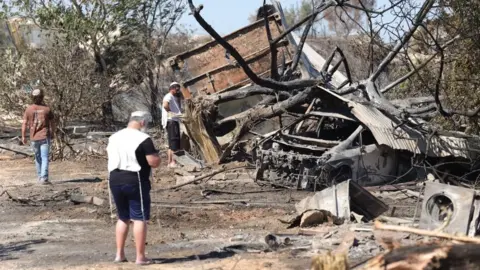
When we visit there is a row of newly burned buildings near the entrance – the result, Shimon says, of an arson attack by Palestinians. Israeli media reported that police were treating the fire as accidental, caused by cigarette butts thrown from a car window.

 EPA
EPAIsrael’s government has previously said it would legalise Havat Gilad. The Israeli organisation Peace Now, which monitors settlements, says it has been unable to do so because much of the land it is built on is recognised by Israel as privately owned by Palestinians, and that the government has instead designated a patch of land to the south of the outpost as state land, to enable settlers to build there.
These issues were dismissed by Shimon, who said international law was irrelevant, because the Bible gave Jews their right to West Bank land.
He criticised Israel’s government and army for failing to back Jewish claims to the land strongly enough, despite a vast expansion in settlements and outposts under the current Israeli government, and the presence of far-right religious-nationalist ministers around the cabinet table who are driving it.
And he criticised the Israeli army for not using lethal force often enough against Palestinians, during confrontations with Israeli settlers.
“The Israeli government and the Israeli army, they like the United Nations – if Palestinians come and Jewish people come, [they] don’t kill the Palestinians, [they] just separate the people,” he said. “Afterwards, because they don’t kill Palestinians, the Palestinians kill us.”
The figures for numbers killed and injured in the West Bank contradict his statement.
The UN Office for the Co-ordination of Humanitarian Affairs (OCHA), which tracks these numbers, says 64 Palestinians were killed in the West Bank from the beginning of this year until 20 July – 18 of them during settler attacks.
At least 12 of those were killed by settlers, three by Israeli forces, and in three other cases it is not yet clear whether soldiers or settlers were responsible. It says one Israeli was killed over the same period.
The number of injuries inflicted by settlers during these attacks has risen sharply to more than three per day this year, OCHA says.
An Israeli soldier who served in the West Bank recently told me he only ever saw fear on the faces of Palestinians, and “never on the face of any Jew that lived there”.
Challenged on this, Shimon accused the global media of “buying the narrative of the Palestinians”, alleging that every Palestinian in the area owned two guns and was preparing to repeat the Hamas-led attacks of 7 October 2023.
“If we don’t wake up and drop them all from this area, from all areas of Israel, even Gaza too, they will come back, and come back [again],” he said.
The conflict between Israeli settlers and Palestinian residents in the West Bank is not an equal one.
Israel occupied the territory during the 1967 Middle East war, and has since built hundreds of settlements and outposts there, housing more than half a million Jews.
Those settlers are protected by Israel’s powerful army, and also by local armed security units which are staffed by settlers themselves.
 Reuters
Israelis in the West Bank are still subject to Israel’s civilian law and enjoy widespread freedom of movement, while Palestinians are subject to Israel’s military occupation and military courts, and are tightly restricted by road closures and checkpoints – a system described by some prominent human rights groups as “apartheid”.
Israel has rejected that label as “absurd and distorted”.
Asked about the Palestinian residents of the West Bank, Shimon laid out three options: live quietly under Israeli rule and ownership of the land; voluntarily emigrate to other Arab or Muslim nations; or “if you don’t want to make peace with us, and you don’t want to get out, I don’t have a choice: I must kill you, and I kill you all,” he said.
This vision from one radical settler seems strikingly close to a plan outlined by Israel’s now-Finance Minister, Bezalel Smotrich, in a blueprint published in 2017, before he joined the government.
In it, he presented a plan for the West Bank in which Palestinians would be told to give up any struggle for a Palestinian state and live quietly under Israeli rule. Those who had “difficulty letting go of national ambitions” could leave the territory, he said at the time, and those who stayed and continued armed struggle against Israel would be killed by Israel’s armed forces.
More recently, while in government, he has pushed for the “voluntary migration” of Palestinians from the Gaza Strip and the re-settlement of Israelis there, and has described Palestinian identity as “an invention”.
One Palestinian living within sight of Havat Gilad told me she watched the outpost from her window constantly, for signs of an imminent settler attack.
Many Palestinians we spoke to said they felt unprotected – that Israel’s occupying army was focused on protecting Israeli settlers, that their own security forces were absent, and that the international community had abandoned them.
“It’s a very bad situation,” one told me. “Europe is busy, America is occupied with Iran, China doesn’t care, Russia is fighting Ukraine, the UN are finished and the Arabs have internal problems. We don’t know what we can do.”
From Havat Gilad, the nearest Palestinian villages are less than a mile away, but the landscape here is divided by Israeli law, Israeli power and mutual hostility.
Additional reporting by Oren Rosenfeld and Rebecca Hartmann
Original source: https://www.bbc.com/