
‘We don’t see why people should persecute us’: Why the teenage David Bowie was already a rebel

‘We don’t see why people should persecute us’: Why the teenage David Bowie was already a rebel

 Alamy
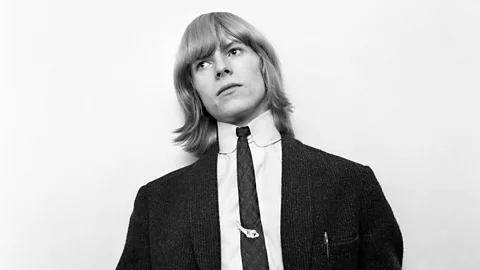
AlamyOn 12 November 1964, the would-be pop star told the BBC that cruelty to hirsute men “just has to stop”. It was a cheeky stunt, but it hinted at the unconventional spirit that Bowie carried into a career of fearless reinvention.
We’re used to seeing awkward high-school yearbook photos of future stars, barely recognisable before fame transformed them. This 1964 BBC television clip is different. The 17-year-old sitting in a current-affairs studio is unmistakably David Bowie, although at the time he was still plain old David Jones. As founder of the Society for the Prevention of Cruelty to Long-Haired Men, he was there to make a plea for understanding. “I think we’re all fairly tolerant, but for the last two years we’ve had comments like, ‘Darling!’ and ‘Can I carry your handbag?’ thrown at us, and I think it just has to stop now,” he told the presenter, Cliff Michelmore.
The Tonight programme’s researchers had picked up on an Evening News interview published a week earlier with “David Jones of Plaistow Grove, Bromley”, the founder and president of the International League for the Preservation of Animal Filament, who “gave up a commercial art job to go into the pop business”. Jones told the newspaper: “Anyone who has the courage to wear hair down to his shoulders has to go through hell. It’s time we united and stood up for our curls.” The mention of the “pop business” provides a clue that this might have been a publicity stunt. After all, he had already appeared on a BBC music programme four months earlier as lead singer of Davie Jones and the King Bees.
By the time the news story made it to television, young Jones and his hirsute friends had coined a catchy new name and were claiming to have the support of 1,000 teenagers all over Britain. In reality, his fellow spokesmen were mostly bandmates from his latest pop group, the Manish Boys. Jones insisted that he had begun letting his hair grow out well before the Rolling Stones arrived with their unkempt locks. “It takes a long time to get this length, you know,” he claimed. The funny thing is that by modern standards, his hair isn’t even all that long. Perhaps that’s why Jones and his friends didn’t need to go to the hairdressers to have their manes shampooed. “Our mums do it,” he revealed. “They’re very good at it.”
While that television item was obviously tongue-in-cheek, the 1960s were the battleground for a culture war over men with long hair. Two decades after World War Two, many members of the older “short-back-and-sides” generation could not understand why young people would choose to express themselves in this way. Some schoolboys found themselves expelled for their shocking rebellion, while older teenagers discovered that the workplace could be a hostile environment. In 1969, 20-year-old welder Graham Wadsworth’s refusal to cut his shaggy hair so outraged his colleagues at a UK engineering firm that they all went out on strike. The company’s personnel manager grumbled, “I understand civil rights and all that, and the young do have different ideas, but we have to set a good image.” The dispute was settled when it was agreed that Wadsworth could return to work, as long as he didn’t eat in the staff canteen.
If anybody is chucked out of a factory job [for having long hair], we’ll get a petition written up – David Bowie
It’s not known whether Jones was involved in negotiations, but in his 1964 interview he did claim that he would stand up for long-haired workers’ rights. “We don’t see why other people should persecute us because of this,” he told Michelmore. “If anybody is chucked out of a factory job or removed from a public bar or saloon bar [for having long hair], we’ll get a petition written up and sent either to the LCC [London County Council] or the people who hold the publican’s licence.”
 Alamy
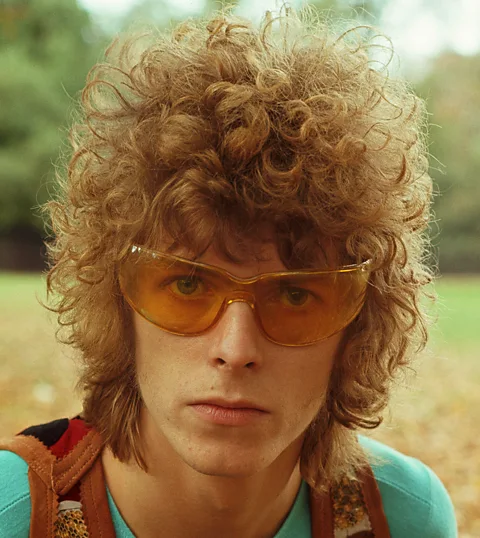
AlamyOnce he had moved on from this particular campaign, Jones would spend the rest of the 1960s fighting to get his pop career off the ground by experimenting with different musical and fashion styles, from sharp-suited mod to wild-eyed hippy. Through his many changes, he would eventually find his own unique voice. The arrival on the pop scene of a rival Davy Jones in the Monkees forced a surname change inspired by Jim Bowie, the Texan rebel depicted in the 1960 film The Alamo. And in 1969, he finally achieved career lift-off when Space Oddity became a hit single in Britain.
From Space Oddity to the internet
With the Moon landings not long out of view, this original song was a shrewd blend of art and commerce. In an archive clip unearthed in the model Kate Moss’s recent BBC podcast, David Bowie Changeling, the singer explained how he related to the sense of isolation explored in Stanley Kubrick’s 1968 film 2001: A Space Odyssey. He said: “I guess so much of what any teenager or young person writes comes from a sense of uniqueness, […] that nobody on Earth could possibly feel as lonely and deprived emotionally as me. I thought, ‘Well, gee, I am Major Tom.’ Here I am in my own cosmic space, and nobody can possibly understand what it’s like to be out here on this umbilical cord attached to my craft – my craft being art. And of course, it led to some really nice silver suits as well.”
In History
In History is a series which uses the BBC’s unique audio and video archive to explore historical events that still resonate today. Sign up to the accompanying weekly newsletter.
On the cover of his next album, The Man Who Sold the World, Bowie wore a dress to accompany his long flowing hair. In 1972 he took on the androgynous persona of Ziggy Stardust: his sci-fi flirtation with sexual ambiguity brought the marginalised into the mainstream. He had come quite a distance from being catcalled for having slightly long hair; he was now inspiring a new generation to express themselves in any way they pleased. Throughout the 1970s, Bowie’s reinventions took him in fresh stylistic directions, from glam to soul, electronic music to post-punk. Bowie told Andy Peebles in 1980 that a big part of his songwriting was “future nostalgia… taking a past look at something that hasn’t actually happened yet”.
More like this:
As the 1980s progressed, he swapped experimentation for slick superstardom. But the 1990s saw him dabbling in everything from industrial rock to drum and bass, while his pioneering music and fashion influenced an emerging wave of new artists. While no longer the resident alien on the pop charts, his curiosity remained undimmed.
By 1999, as an elder statesman of rock, Bowie was once again looking towards the future. As a young man he had dreamed of becoming a musician “because it seemed rebellious”, he told Newsnight’s Jeremy Paxman. If he was starting out today, he said, his medium of choice would be the internet because it “carries the flag of being subversive and possibly rebellious and chaotic, nihilistic”. He added: “I don’t think we’ve even seen the tip of the iceberg. I think the potential of what the internet is going to do to society, both good and bad, is unimaginable. I think we’re actually on the cusp of something exhilarating and terrifying.” When you recall that this was a time when people’s minds were being blown by the likes of Ask Jeeves, his foresight is astonishing. “The state of content is going to be so different to anything that we can really envisage at the moment,” he added.
Once again sporting long hair, Bowie shared a story about meeting the then Prime Minister Tony Blair that showed just how much the times had changed since 1964: “I wore a vicar’s dog collar. Nice black suit, black shirt with a dog collar and a pair of women’s high heels. And he didn’t bat an eyelid.”
—
For more stories and never-before-published radio scripts to your inbox, sign up to the In History newsletter, while The Essential List delivers a handpicked selection of features and insights twice a week.
Original source: https://www.bbc.com/
