


We’re getting mealtimes wrong – here’s the best time to have dinner

 Getty Images
It’s not only what you eat that matters – your body clock plays an important role in how you metabolise food.
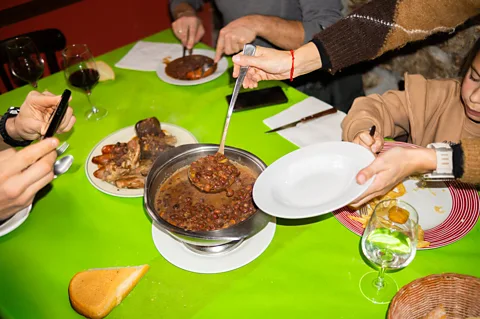
“Have breakfast like a king, lunch like a prince and have dinner like a pauper,” my Spanish friend and colleague Javier Hirschfeld told me when I asked about typical Spanish eating habits. It’s a saying that has been drilled into him from an early age.
In Spain, it’s common for lunch to be your biggest meal of the day while evening meals tend to consist of light bites. “Some people skip dinner altogether or have a piece of fruit and yoghurt,” he says.
From reducing obesity to preventing cardiovascular disease, numerous studies now show that our internal body clock, or circadian rhythm, plays a powerful role in how we process food – and our overall health. Here’s why – and how to schedule your meals to capitalise on it.
Set your clock to the right ‘time’
Marta Garaulet, from the University of Murcia in Spain, first became interested in the impact of meal timings after making observations in her weight-loss clinic. Over a decade ago, she observed two patients who experienced different weight-loss results, despite living together and following the exact same diet.
We’re not the same person in the morning and the evening from a biological point of view – Frank Scheer
One had lunch around 13:00, while the other could only eat later because of her class schedule. “That was the only difference,” says Garaulet. The student eating an earlier lunch had lost much more weight after six-weeks. This led her to investigate the intriguing possibility that meal timing itself could have a huge influence on weight loss.
Together with colleagues from the University of Murcia, Garaulet followed 420 adults in Spain who took part in the same weight-loss programme over 20 weeks to find that those who ate an earlier lunch lost more weight and lost it more quickly compared to those who chose to eat lunch later in the day.
Similarly, in a small randomised controlled trial, 32 healthy women ate the same meals for two weeks. Those who ate a later lunch showed poorer blood sugar control and burned fewer carbohydrates. Numerous studies have since found that our circadian rhythm influences our hunger, digestion and metabolism.
But why should eating the exact same food at a different time of day have such a powerful effect? When I asked this question to Frank Scheer, a professor of medicine and neuroscientist at Brigham and Women’s Hospital in Boston, Massachusetts, he told me that it’s because “we’re not the same person in the morning and the evening from a biological point of view.” Our internal body clock regulates almost all aspects of our physiology, he says.
That’s because eating at a time when our body clock suggests it’s time for sleep could create a biological mismatch called “circadian misalignment.”
One example of this can be seen in how we regulate blood sugar. In a 2022 study of more than 800 adults, researchers gave each one a glucose drink designed to mimic the carbohydrate content of a typical evening meal. They found that participants processed it less efficiently when they consumed it one hour before bedtime rather than four hours earlier.
Those who drank it closer to bedtime had higher blood sugar levels and produced less insulin, the hormone that helps to regulate our blood sugar. Researchers believe melatonin, which rises as the body prepares for sleep, plays a key role in this process.
 Getty Images
“If you eat when melatonin is elevated in the evening, your glucose control is going to be impaired,” says Scheer, who was also involved with the study. The effect was even greater in people carrying a common variant of the MTNR1B gene, which has been associated with an increased risk of type 2 diabetes. Over time, later eating could therefore increase the risk of developing the condition, which has steadily been increasing worldwide.
Eat earlier to be less hungry
The effects of later eating may extend beyond blood sugar control. Research has found that later eating made participants feel hungrier the next day by disrupting the hormones that regulate appetite and satiety. Those who ate later produced less leptin, a hormone that tells our brains when we’re full.
At the same time, meal timing influences how our bodies store fat. Instead of breaking fat down, later eating can lead our cells to store fat. Over time, this could make it more difficult for the body to stay at a healthy weight.
Meal timing may therefore be especially important for people who carry genetic variants that make them more likely to put on weight. In a study of nearly 1,200 adults, an international team of researchers – including Scheer – found that later eating was linked to a higher body mass index among individuals with higher risk of obesity, while eating earlier reduced this risk.
Eat a big breakfast for better heart health
There may be heart health benefits to earlier eating too. In a study of more than 100,000 people in France, those who ate breakfast later had a higher risk of cardiovascular disease. The researchers also found that a longer overnight fast, achieved by eating earlier in the evening rather than delaying breakfast, was associated with better heart health.
This may be particularly relevant for shift workers, as well as other groups vulnerable to “circadian disruption,” researchers note. For those who do work at night, the advice is therefore to limit food intake to the daytime where possible – though this may not be safe for everyone (eg health workers may need to eat to keep their energy levels up).
If you do get hungry, stick to smaller protein-rich snacks and try to delay eating breakfast to the morning, if it fits your schedule.
Be mindful of whether you are a ‘lark’ or ‘owl’
Of course, when we eat isn’t entirely within our conscious control. Our chronotype – the now concept that some of us are morning larks or night owls – has been found to influence our mealtimes.
Morning types are more likely to follow a Mediterranean diet, whereas evening types are more likely to delay meals and eat more energy-dense foods later, says Giovanna Muscogiuri, an assistant professor at the University of Naples Federico II in Italy.
Crucially, our chronotype also influences how our bodies respond to food. Morning types tend to have earlier peaks in insulin sensitivity as well as an earlier release of melatonin than evening types, who as a result of later eating, are more vulnerable to poorer glucose control and weight gain.
She therefore says that we should be more mindful of our “lark” or “owl” predisposition and that later eaters would benefit from gradually adopting earlier evening meals.
Then we also need to consider that the duration and quality of our sleep affect our hunger and cravings. If we are sleep-deprived we are more likely to overeat and choose energy-dense foods, which might lead to weight gain over time, says Muscogiuri.
How to eat smarter
The practical advice is relatively simple. Aim to eat at regular times and eat fibre-rich carbohydrates such as whole grains, legumes (beans, peas and lentils) as well as fruit, earlier in the day when the body is better able to process them. In the evening, opt for a lighter meal, ideally one rich in protein.
In a recent review Muscogiuri also recommends that in the evening, it would benefit us to include foods that help to support sleep, such as nuts and seeds, as well as tryptophan-rich sources of protein, such as chicken, salmon and tuna, as tryptophan has been shown to improve sleep quality.
I’m certainly going to pay closer attention to my internal body clock in future. The Spanish habit of making lunch the largest meal is particularly appealing – one thing I might try is cooking in the morning before my work day begins. Perhaps I’ll even have a paella.
So, what time is the best time to have dinner? Well, there isn’t really a best time – but ideally we should eat our largest meal earlier in the day, and have our evening meal at least three hours before we go to bed.
* Melissa Hogenboom is a senior health correspondent at the BBC and author of Breadwinners and The Motherhood Complex. She is melissa_hogenboom on Instagram.
—
For trusted insights on health and wellbeing, sign up to the Health Fix newsletter by senior health correspondent Melissa Hogenboom who also writes the Live Well For Longer and Six Steps to Calm courses.
Original source: https://www.bbc.com/